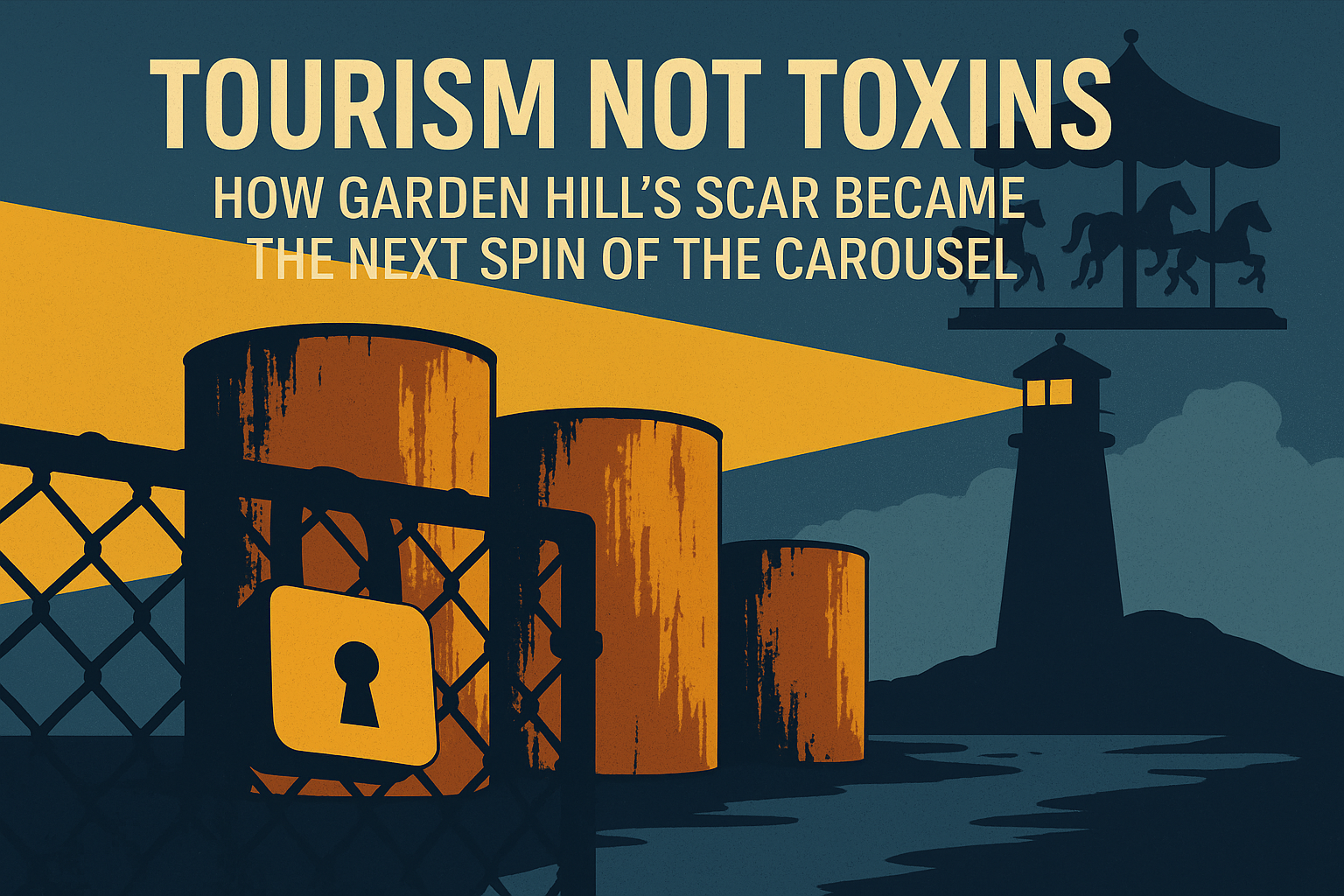
Just beyond the cliffs of Cape St. George, the Garden Hill oil site still sits — a field of rusting tanks and weeds, long past the days when it was pitched as Newfoundland’s next frontier of prosperity.
For nearly 30 years, Garden Hill was promoted as a turning point. Press releases and political speeches in the late 1990s and 2000s claimed the site would prove Newfoundland could stand with Alberta or offshore Norway. Small-scale tests were presented as breakthroughs, and consultants framed it as the first step in unlocking massive reserves. Local residents were told it could spark jobs, revitalize the coast, and restore dignity to a region sidelined from larger developments.
The reality was much smaller. Garden Hill produced little oil, generated few jobs, and quickly fell short of the promises. By the time the lease expired, the land was scarred with corroded tanks, abandoned equipment, and overgrown weeds — a monument not to prosperity, but to hype.
Today, with the site sliding further into decay, it is being rebranded not as failure but as opportunity.
From Oilfield to Heritage Script
The Environmental Transparency Committee (ETC) recently presented Garden Hill as a blank slate for “clean tourism.” (User-Provided Screenshot) In a post accompanied by photographs of rusting tanks and battered signage, they spoke of Mi’kmaq, French, and Acadian ancestors, of lighthouses as beacons, of scars turned into heritage.
Their language was deliberate:
- Garden Hill was described as a “rusting graveyard.”
- The corroded tanks were called an “industrial scar.”
- And their call to action ended with “Let’s bring back the light. Let’s protect our heritage. Let’s welcome the future.”
It was polished rhetoric, and for many readers it worked. But heritage language is not neutral. It is a tool — and in this case, it is being used to overwrite accountability. Garden Hill is not just a wound waiting for healing. It is the mark of a carousel that has been spinning for decades — and the same hands are waiting to climb back on.
The Scar’s True Authors
Garden Hill was not an anonymous project. It was operated by PDI Production, a subsidiary of Enegi Oil, under the leadership of Ali Chaisson as CEO/GM from 2007 to 2009¹. He remained involved with both PDI and Enegi through 2013², while also taking roles with Investcan Energy and Québénergie³, both vehicles of French capital tied to the Bettencourt family’s SCDM group⁴.
This overlap matters. Chaisson was not just an oil executive. During those same years, he had also served as Executive Director of the Fédération des francophones de Terre-Neuve et du Labrador (FFTNL) from 1997 to 2006⁵ ¹⁰ ¹¹ ¹², the organization recognized as the official voice of the Francophone minority of Newfoundland & Labrador.
That meant cultural institutions and oil ventures were being steered through the same network of influence. It also meant that figures like Catherine Fenwick — later active in local activism and tone-policing in 2022⁶ — were working directly under him. For many years, and indirectly today as the Director General of the SNAB⁷, she has remained connected to the same orbit.
Garden Hill’s rusting tanks are not just the residue of industry. They are the visible reminder of a consultant network that managed both economic projects and cultural institutions at the same time, ensuring that when one scheme collapsed, another could be narrated into being.
The Heritage Cloak
The ETC’s post about Garden Hill is a masterclass in the cultural cloak. Oil decay is reframed as tourism promise. Industrial abandonment becomes an invitation to “bring back the light.”
By invoking ancestors, lighthouses, and cultural pride, the ETC cloaks the pivot in sacred language. To oppose their proposal is to risk being seen as opposing Mi’kmaq, French, or Acadian heritage itself. That is the power of the cloak — it fuses identity with project approval, leaving little room for dissent.
But this isn’t lived heritage speaking. It is the heritage script, polished in classrooms, organizations, and consultant offices, recycled now to soften the pivot from oil to tourism. The language is emotionally appealing, but strategically it functions to silence critique and redirect attention away from who left the scar in the first place.
Governance Capture, Not Governance Gap
Analysts often talk about Newfoundland’s governance gap — weak councils, fragile institutions, and a vacuum of leadership. But Garden Hill shows something different: governance capture.
By the year 2000, Tony Cornect — part of that same cohort — was mayor of Cape St. George⁸. His peers filled ARCO, FFTNL, and later the ETC. What looked like institutional pluralism was in fact a monopoly of loyalty: the same circle holding the levers of councils, cultural boards, and local organizations.
The consequence was predictable. When Garden Hill collapsed, there was no independent body left to demand accountability. The pivot to tourism was presented as natural, inevitable — because the only voices left in charge were the same ones who had overseen the original failure.
The Familiar Circle
This circle of influence was not small. It included names that continue to surface across boards, councils, and committees: Martin Chaisson (Heritage Canada), Rae Miller (CBDC), Nadine Tallack (Head, ETC), and Duran Felix (ETC), alongside others from the same generation. Different roles, different titles, but the same cohort — moving through politics, activism, and institutions, often overlapping in ways that left little space for independent voices. And above them all, Robert Cormier — with posts at the CBDC, as former deputy mayor of Cape St. George, former Director General of ARCO, and principal of Our Lady of the Cape — under whose watch this generation was formed and through whom many of these networks remained tied together.
The Carousel in Motion
Garden Hill is not an isolated case. It is part of a larger cycle that has defined Newfoundland for decades.
- Phase One: Oil prosperity, promises of jobs and renewal. Politicians and consultants speak of “unlocking potential,” and companies issue glowing press releases.
- Phase Two: Collapse, abandonment, rusting tanks. Companies dissolve or rebrand; consultants move on to the next file.
- Phase Three: Rebranding, with heritage, tourism, or renewables as the new saviors. The same people reappear to narrate the transition.
This cycle is visible not only at Garden Hill but across other projects:
- Fracking proposals that stirred controversy before fading into consultant reports.
- Wind and hydrogen schemes marketed as green salvation, even as financial backers come from the same global networks.
- Tourism pivots where heritage and culture are repackaged into ESG-friendly narratives.
The rhetoric changes — oil, fracking, hydrogen, tourism — but the pattern doesn’t. The carousel keeps turning, and the flock that rides it remains the same.
When the Fence Matters More Than the Site
In 2022, I observed the Garden Hill site closely on my first trips across the mountains. The perimeter fence around Garden Hill had been left unkept for so long that parts of the wire mesh had collapsed to the ground. It stood as a quiet symbol of abandonment — no one watching, no one maintaining, no one caring.
But then the public conversation shifted. As wind turbines became the new controversy and environmental language began dominating local debates, the optics of Garden Hill suddenly mattered again. On my next trip, the fence had been restored.
Nothing inside had changed — the same corroded tanks, the same scar. But the outer boundary was made presentable, just enough to suggest control, just enough to signal that someone was paying attention. The repair was cosmetic, not restorative. And that, in many ways, reflects the entire pattern: appearance managed, substance ignored.
Why the Pivot Persuades
The ETC’s Garden Hill proposal works because it offers emotional relief. For residents, staring at rusting tanks is depressing; imagining walking trails, cultural signage, and tourists admiring a restored site feels hopeful. It shifts the conversation from decay to pride.
But the hope is conditional. Without accountability, this is not reclamation. It is repackaging. The same networks that oversaw the collapse of Garden Hill now present themselves as its redeemers. That is not transformation. It is recycling.
Pointing It Out
Inside their circle, no dissent was raised. Outside it, I point out what is left unsaid. Garden Hill is not a symbol of renewal. It is a monument to loyalty filters, governance capture, and the erasure of authentic voices.
To frame it as tourism without accountability is not healing. It is recycling the scar for another round of the carousel. And unless that cycle is broken, the community will continue to see its future narrated by the same flock, while the scars — physical and political — are left unhealed.
References
[1] The Consultant’s Carousel: How Ali Chaisson Turned Energy Projects into Personal Fiefdoms – Bayman’s Paradox (2025). https://baymansparadox.com/explore/governance/post.php?id=152
[2] Canada–Newfoundland and Labrador Offshore Petroleum Board – Environmental Assessment Report (confirms PDIP is a subsidiary of Enegi Oil plc and operator of PL2002-01 / Garden Hill). https://www.cnlopb.ca/wp-content/uploads/pdippp3d/pdieareport.pdf
[3] Investcan Energy Corporation corporate profile (2009–2013). Corporations Canada. https://ised-isde.canada.ca/
[4] Pétrolia – Partenaires (states “Québénergie est une filiale de SCDM”). https://www.petroliagaz.com/fr/corporatif/entreprise/partenaires.html
[5] FFTNL – Our Story (leadership listing; shows Ali Chaisson in leadership, 1996–2006). https://www.fftnl.ca/en/fftnl/our-story/
[6] Erased for Being Early: The Sanitization and Smearing of Independent Voices – Bayman’s Paradox (2025). https://baymansparadox.com/explore/peer-pressure/post.php?id=146
[7] Société de l’Acadie du Nouveau-Brunswick (SANB) – L’équipe (lists Ali Chaisson as Directeur général). https://www.sanb.ca/fr/la-sanb/equipe
[8] Government of Newfoundland and Labrador – Municipal directory: Cape St. George mayors. https://www.gov.nl.ca/mpa/municipal-directory/
[9] The Technocracy of the Base: Why Grand Agendas Flourish Where Local Governance Fails – Bayman’s Paradox (2025). https://baymansparadox.com/explore/governance/post.php?id=145
[10] FFTNL Annual Report 2005–2006 (PDF; lists “Directeur général : Ali CHAISSON”). https://www.francotnl.ca/FichiersUpload/Documents/20100742FFTNL_Rapport_annuel_2005_2006.pdf
[11] FFTNL Annual Report 2006–2007 (PDF; president’s message notes Ali Chaisson’s resignation). https://www.francotnl.ca/FichiersUpload/Documents/20100758FFTNL_Rapport_annuel_2006_2007.pdf
[12] Office of the Commissioner of Lobbying of Canada – FFTNL in-house registration (Responsible Officer: ALI CHAISSON, Directeur général; start 1998-11-11). https://lobbycanada.gc.ca/app/secure/ocl/lrs/do/vwRg?cno=12185®Id=493492