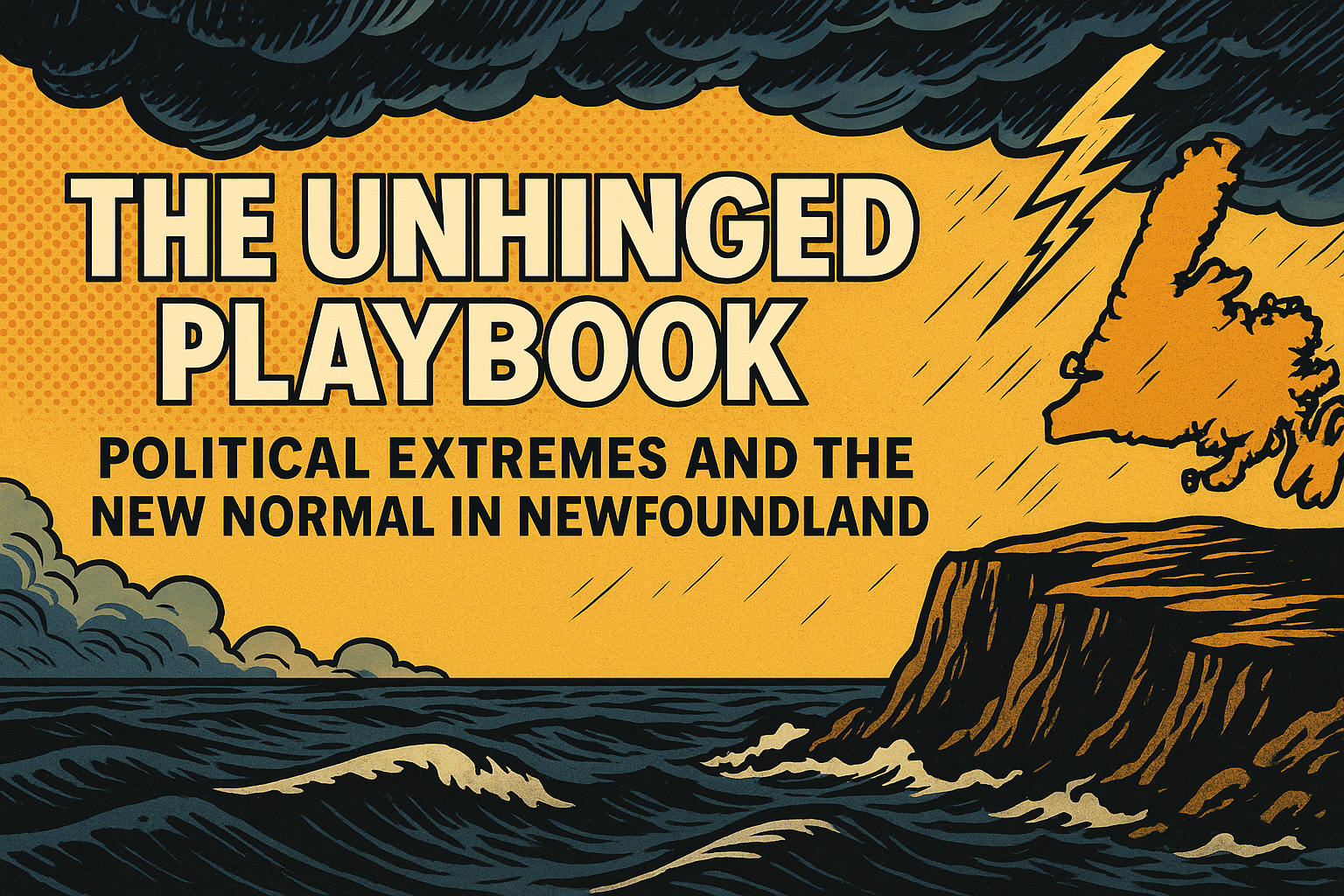
In Newfoundland and Labrador, politics no longer lives in the middle. Public debates swing between promises of salvation and warnings of doom, between claims of total loyalty and accusations of betrayal. What might look like unhinged rhetoric elsewhere has, in this province, become the accepted script.To understand how extremes became normal, one must trace both the fiscal habits of government and the legacy of resource collapse that taught communities to expect nothing less.
Fiscal Extremes and Bailout Politics
Economist Xinli Guo shows how Newfoundland municipalities operate under chronic soft budget constraints: small towns with narrow tax bases know that the province will step in if deficits grow too large¹. This dynamic encourages overspending, risky borrowing, and strategic pleading for rescue. In practice, communities learn that moderation yields nothing while dramatic crisis gets rewarded. The result is a fiscal theatre where shouting the loudest — about poverty, about abandonment — becomes a rational strategy. The extremes aren’t accidental; they’re baked into how money flows.
The long-term consequence is a culture of fiscal brinkmanship. Councils and mayors posture against St. John’s or Confederation itself, not because they believe every accusation, but because history shows that creating a sense of crisis can unlock new transfers. What Kornai once described as the “soft budget constraint” is lived locally as a political performance — where survival requires going to extremes. In this environment, moderation is punished because quiet towns risk being overlooked, while loud, even unhinged ones, attract attention and bailout money.
Resource Collapse as Script
Historical memory deepens this tendency. Jessica Hogan’s research demonstrates how the cod fishery collapse continues to frame perceptions of resource and energy projects². For many, the fishery was not just an industry but a way of life, and its collapse created a cultural wound. That trauma carries forward into attitudes toward development: hydro megaproject overruns, mining bankruptcies, and offshore oil volatility are all interpreted through the same binary lens of “saviour or scam.”
Projects like Churchill Falls and Muskrat Falls began as promises of emancipation — the chance to escape dependence on Ottawa or revive economic fortunes. But each delivered bitter lessons: hidden liabilities, skyrocketing debts, and inquiries that revealed unprincipled or reckless decisions. Offshore oil, once responsible for over a third of the province’s GDP, collapsed as global prices fell, stripping away prosperity as quickly as it appeared. Mining ventures closed with little warning, leaving workers abandoned and communities hollowed out. These repeated shocks reinforce a learned expectation: prosperity is temporary, collapse inevitable.
Hogan captures the resulting mood as one of “sceptical optimism” — residents express hope in new industries like wind energy, but they pair that hope with caution, even cynicism, rooted in long memories of betrayal². This emotional economy is fertile ground for extremes: when every opportunity feels like either salvation or another con, the middle ground loses credibility.
From Boom–Bust to Polarization
The oil era illustrates how quickly Newfoundland can swing between extremes. During the boom years of the early 2000s, when offshore royalties surged from the Hibernia, Terra Nova, and White Rose fields, the province proudly wore the badge of being a “have” province — breaking free of federal equalization for the first time in modern memory. The prosperity of 2008 to 2013 brought new infrastructure, high public-sector wages, and the illusion of permanence — an illusion that would soon shatter.
Then came the 2014–2016 oil price collapse. Global crude fell from over $100 a barrel to under $40, wiping out royalties, investment, and confidence almost overnight². By 2016, unemployment was rising, deficits ballooned, and the provincial government imposed austerity measures that triggered widespread public anger. The reversal was not only economic but psychological. The crash confirmed for many that moderation and careful planning were powerless against global tides — that every success story in Newfoundland was only one downturn away from collapse.
Scholars of governance note that Newfoundland has repeatedly managed such crises not through resilient local institutions, but through centralized, often patronage-driven politics³. Rather than enabling autonomy and adaptability, the state tends to recentralize control, deploying bailouts, subsidies, or megaprojects as political gestures of salvation. This deepens the cycle of polarization, as communities are drawn into struggles over who will receive state rescue instead of developing diverse, sustainable economies.
The memory of Muskrat Falls encapsulates that pattern. Promised as the project that would finally free Newfoundland from Churchill Falls, it instead delivered billions in overruns, soaring electricity costs, and a scathing public inquiry that exposed deep institutional failure. For many, the project’s collapse confirmed what the oil crash had already suggested: that “moderation” — the promise of careful, technocratic management — was a façade. Once again, the middle ground disintegrated, leaving only extremes: loyal defenders insisting it was necessary, and critics calling it a historic betrayal.
Patronage and Factionalism as Reinforcement
Overlaying these economic shocks is a governance culture steeped in patronage. Newfoundland politics has long blurred the lines between community advocacy and political loyalty. Dunn describes how overlapping elites in St. John’s relied on patronage networks to consolidate power, rewarding allies and punishing dissent⁴. In small communities, this dynamic translates into factionalism, where residents must align themselves with either the “for” camp or the “against” camp on every issue — whether the matter is a new fish plant, a wind project, or a bailout package.
This polarization is further reinforced by the architecture of local government itself. Weak councils, limited taxation authority, and dependency on provincial approval mean that community leaders often function as brokers for patronage rather than autonomous decision-makers. Local debates mirror provincial extremes: loyalty and silence on one side, vocal dissent on the other. There is little incentive to build measured compromise because the institutional framework rewards factional alignment.
The combined effect is a system in which citizens are trained, at every level, to think and act in extremes. Whether seeking bailouts, reacting to project promises, or navigating patronage networks, moderation rarely pays. Extremes, by contrast, attract attention, loyalty, and sometimes tangible rewards.
How Extremes Become the Playbook
Once these legacies are normalized, factions learn to weaponize them. Supporters of large projects herald “historic opportunity”; critics warn of “historic betrayal.” Media and officials reinforce the polarization because it aligns with well-worn public narratives. Consensus is redefined as compliance, while dissent is branded disloyalty. The playbook is unhinged only on the surface; underneath, it reflects adaptive strategies in a system where the middle ground rarely holds.
Residents themselves testify to this cycle. Hogan’s interviews reveal the persistence of sceptical optimism: cautious hope paired with suspicion². When industries collapse, people remember the chorus of voices — corporate, government, and media — that once promised revival. When bailouts arrive, they notice that the loudest claimants get rewarded. Over time, the lesson becomes clear: survival means playing at the edges. Extremes are no longer outliers; they are the currency of political participation.
The Cost of Normalization
The normalization of extremes corrodes the democratic fabric. Younger residents hesitate to enter politics when moderation looks like weakness. Local councils fracture along “for” or “against” lines, unable to chart pragmatic courses. Citizens internalize the idea that only total support or total opposition counts. The danger is not only polarization but paralysis: when every debate becomes a test of loyalty, communities lose the ability to evaluate policies on their merits. Renewable energy, municipal finance, or social programs are judged less on outcomes than on whether they signal allegiance to one extreme or another.
At the same time, residents carry deep ambivalence. Many acknowledge the need for new industries and believe in the potential for renewal, but their optimism is weighed down by memories of collapse, debt, and betrayal². This tension means even moments of genuine opportunity are filtered through mistrust. Extremes become coping strategies — ways to manage hope and disappointment in a province where moderation has too often failed.
Conclusion
The “unhinged” playbook is not a sudden madness but the long product of institutional incentives and cultural memory. Municipal bailouts taught communities to game the system. Resource collapses taught them that every promise hides a trap. Patronage politics taught them that loyalty is rewarded, dissent punished. Together, these forces normalize extremes, making them the expected, even rational, mode of political expression.
The challenge now is not to ridicule extremes but to recognize them as predictable outputs of Newfoundland’s political economy. Only by understanding their roots can communities begin the harder task of restoring trust in moderation — building institutions resilient enough to resist both fiscal theatre and the ghosts of collapse.
The recent provincial election in Newfoundland and Labrador delivered a sharp shift in power: the Progressive Conservative Party under Tony Wakeham secured a majority government following a decade of Liberal rule, signalling voter appetite for change⁵. Yet for a province whose public life has long oscillated between extremes, this “fresh start” may simply open the next chapter of the same unpredictable cycle. The machinery of patronage, the lure of large-scale projects, and the temptation of grand gestures remain intact. In that sense, the message from voters might best be summed up as: be careful what you wish for. The new administration now inherits the same structural conditions that made the previous extremes normal — and if it fails to confront them, the next wave of polarization may already be forming.
See also
- Rehearsed Truth (safe narratives repeated until they’re “fact”)
- Consensus as Control (compliance framed as unity)
- Factional Mirrors (polarization & patronage traps)
- When Silence Becomes Evidence (academic narratives sell acceptance)
- Imported Outrage, Local Silence (external noise vs local quiet)
References
[1] Guo, X. (2025). Optimal Transfer Mechanism for Municipal Soft-Budget Constraints in Newfoundland. https://arxiv.org/abs/2508.02171v3 (Local Download)
[2] Hogan, J. L. (2025). The legacy of the cod fishery collapse: Understanding wind energy acceptance in Newfoundland through energy justice and place. Energy Research & Social Science, 127, 104274. https://doi.org/10.1016/j.erss.2025.104274 (Local Download)
[3] Van Assche, K., Greenwood, R., & Gruezmacher, M. (2022). The local paradox in grand policy schemes: Lessons from Newfoundland and Labrador. Scandinavian Journal of Public Administration https://www.sciencedirect.com/science/article/abs/pii/S0956522122000197?via%3Dihub (Local Download)
[4] Dunn, C. (2004). The quest for accountability in Newfoundland and Labrador. Canadian Public Administration, 47(2), 184–206.
https://doi.org/10.1111/j.1754-7121.2004.tb01899.x (*Note: Access may require a subscription or institutional login via Wiley Online Library.*)
[5] 2025 Newfoundland and Labrador general election. (2025). In Wikipedia. https://en.wikipedia.org/wiki/2025_Newfoundland_and_Labrador_general_election