
The Boat and the Law
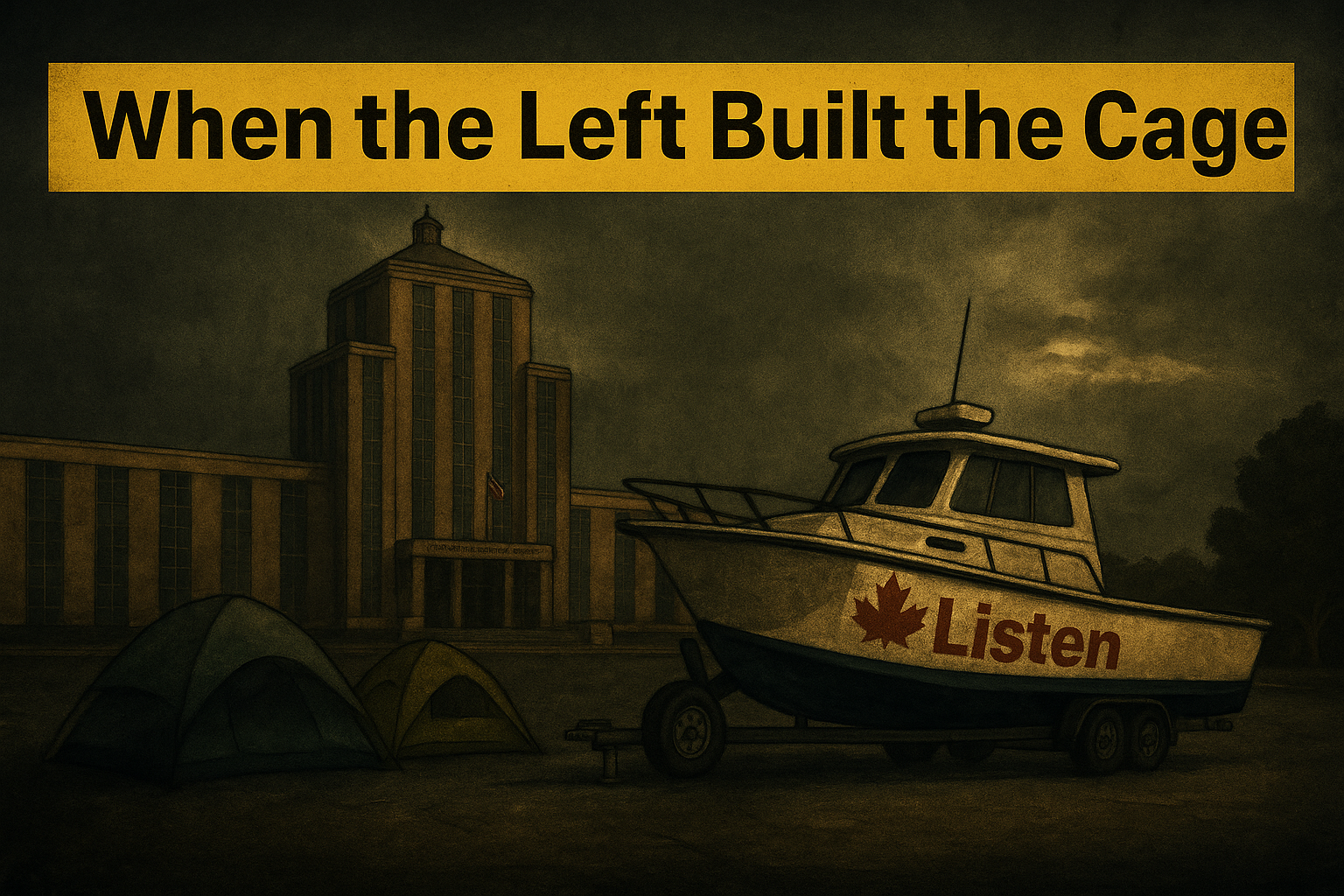
In November 2024, a modest but pointed protest unfolded outside the Confederation Building. A colourful fishing boat was parked on government property, banners unfurled, voices raised about energy policy and transparency. Within hours, police moved in and arrests were made under a previously little-known regulation: NLR 29/24 – Unauthorized Use of Government Property Regulations¹.
This law did not originate because of the boat protest. It originated because a much earlier protest on the same grounds had forced the issue of public-property occupation into the regulatory spotlight.
Tent City for Change (2023–2024)
In the fall of 2023, an encampment formed outside government offices in St. John’s. Tents appeared on the grounds of the Colonial Building and Bannerman Park. Residents experiencing homelessness joined volunteers and allies under the banner Tent City for Change²³. They proclaimed housing as a human right, called for wraparound supports, and refused to disperse through winter.
“The Government of Newfoundland and Labrador is infringing on the human rights of residents of Tent City through both the threat of forced eviction … and neglecting to provide regular access to sanitation facilities.”
— St. John’s Status of Women Council²
By winter 2023–24 the site had become both a symbol and a problem. Officials spoke of liability, safety risks, and public-image damage. Internal discussions revealed they lacked the legal tools to remove people who weren’t committing crimes. That legal vacuum meant the encampment had converted social failure into administrative headache.
The Timeline That Tells the Truth
- Summer 2023 – Fishermen’s Protest
- Fish harvesters rallied over licensing and coastal access. No property-use regulation followed⁴.
- October 2023 – Tents Appear
- Sleeping encampments were erected outside the legislature. They persisted through snow, rain, and cold.
- Winter 2023–24 – Legal Vacuum
- Government departments flagged “public-grounds management” as a legislative gap.
- April 2024 – Drafting the Regulation
- A draft of NLR 29/24 circulated under the Public Works Act. Language mirrored cabinet memos: safety, liability, unauthorized structures¹.
- May 3, 2024 – Eviction and Enactment
- A dawn-raid removed the Tent City. On the same day, Cabinet enacted the regulation.
- November 2024 – Regulation Re-Used
- The boat protest was confronted with the exact tool created during the encampment crisis.
From Compassion to Control
On its face, NLR 29/24 appears innocuous: a ban on unauthorized use of government property¹. But in practice, it restructured the power dynamic. The government no longer had to negotiate with moral claims—there was now a rule to enforce. A shift occurred: community protest became regulatory breach.
The Law’s Second Life
The 2024 protest was not about homelessness. It stood in the tradition of independent voices opposing wind megaprojects, extractive deals, and elite energy policy. But the law applied not to what was said—only to where a boat was parked!
“They’ve had no voice … so this was our only way to get in here and get attention and try to get a voice, and now they’re taking that from us too.”
— Protect NL organizer, outside Confederation Building⁵
One woman was arrested. All three were charged. A trial was set for October 21, 2025, and by late October the legal outcome remained unclear⁶⁷. Federal charges were dropped; however, the provincial charge under NLR 29/24 remained in effect.
The line is clear: tents inspired the law; the law confronted the boat.
In the months leading up to the October court appearance, members of the St. John’s social justice sphere—many previously active in Tent City and housing advocacy—appeared around the women of Protect NL, but not necessarily in support of the protest itself. Their engagement often took the form of election-season visibility, indirectly boosting NDP candidates who echoed broad justice messaging.
While some may have acted out of genuine concern or lingering guilt, the alignment often looked more like political choreography than direct solidarity. It reinforced the sense that Protect NL’s story had become a convenient backdrop—not just for energy dissent, but for the seasonal rebranding of progressive networks during a campaign cycle.
Some observers have noted that Protect NL itself may lean toward NDP-aligned messaging, though its members publicly maintain a posture of grassroots independence.
Administrative Reflex — The Newfoundland Pattern
Newfoundland’s pattern is reactive containment:
- Cod collapse → fishery boards.
- Muskrat Falls opposition → protester surveillance zones.
- Tent City → NLR 29/24 →Present day events.
Economist Xiao Guo (2025) calls this “soft-budget constraint governance” — a provincial reflex shaped by dependency on federal bailouts, where systems optimize not for change, but for continuity:
“Public institutions in Newfoundland are not always optimizing for efficiency or justice. They are optimizing for continuation.”
— Guo (2025)⁹
Within this framework, any crisis—housing, poverty, food access, or even water rights—becomes a risk to be administratively managed, not resolved. Even community compassion becomes performance if it threatens predictability.
The Funding Web: Grants, Deliverables, and Diminished Dissent
Activist NGOs, mutual-aid groups, and housing coalitions operate within a funding climate designed by the very state they challenge. Public grants now demand “community engagement,” “reconciliation partnerships,” or “climate resilience deliverables.” Values that appear radical—but ensure stability.
By late 2024, the same justice language used at Tent City had been absorbed into state programs⁸. Housing became an initiative. Food insecurity became a data point. Water access was framed in terms of infrastructure resilience. ProtectNL was now working with a MUN affiliated video documentary about water and food insecurity. And the same activist machinery that once fed dissent now fed grant reports.
“The province’s unique status as a fiscal recipient shapes how institutional actors internalize protest, funding uncertainty, and administrative discretion.”
— Guo (2025)⁹
This is performative pluralism: many voices, singular sponsor.
Ideological Self-Preservation
Several prominent voices who supported Tent City have since pivoted into government-adjacent roles.
Robin LeGrow, previously known for advocacy on housing and poverty issues, became Director of Community and Sector Engagement at End Homelessness St. John’s, an organization that partners closely with provincial programs and housing initiatives.
Kerri Claire McNeil, a vocal ally of social justice causes, went on to serve as Vice-President of the Newfoundland and Labrador Federation of Labour and has participated in multiple public consultations on government climate and equity strategies.
Whether these transitions were strategic, ideological, or simply a means of maintaining voice within a changing landscape, the effect is the same: dissent is increasingly realigned to work within institutional structures. Advocacy becomes facilitation. The podium becomes a panel.
And to readers who have been paying attention since 2022, both names may be familiar. Robin LeGrow and Kerri Claire McNeil were active in Facebook discussion threads and groups aligned with ETC and affiliated circles, often offering guidance, support, or signal boosts to community organizers. Their presence overlapped with groups connected to EnviroWatchNL and similar networks that blended environmental advocacy with social-justice messaging.
Guilt Reframed as Stewardship
Some who once championed direct action may have felt the unintended consequences of their protests—such as contributing to the legal justification for NLR 29/24 (Hi Robyn!). By embracing initiatives framed around housing reform, climate equity, or community partnerships, they maintained public credibility while staying within boundaries acceptable to funders and institutions.
Narrative Capture
Over time, both government and NGOs re-framed protest demands using approved, fundable vocabulary:
“just transition,” “equity lens,” “wraparound supports,” “food access.”
Language that sounds progressive, but quietly narrows the terms of engagement. The result?
Dissent becomes data. Protest becomes programming
In each case, protest is domesticated. Its teeth are filed down. It is made sponsor-friendly.
Beyond Ideology
Look closely and you’ll see: both Left and Right now operate the same machinery. The Left controls through justice framing; the Right through order and security. But both demand obedience to policy.
- Whether the issue is homelessness or hydrogen,
- Whether the symbol is a tent or a boat,
The response is the same:
Enforce the rule. Contain the message. Resume normalcy.
When a rule made for one cause blocks another, dissent is no longer oppositional—it’s been formatted.
Polite Gas-lighting: The Newfoundland Reflex
This isn’t brute authoritarianism. It’s polite, professional, procedural:
- You are thanked for your feedback.
- You are invited to a working group. Send an email or two.
- You are encouraged to apply for funding.
The language is inclusive, but the space is cramped.
And when the same voices show up at every meeting—because those are the funded ones—opposition looks full, but feels empty.
Newfoundland is not broken.
It is choreographed.
Closing Reflection — The Caged Commons
When Tent City ended, the government absorbed its moral language.
When the boat was towed, the protest was criminalized.
The same mechanism is visible in energy approvals, food access forums, and even water policy consultations: the state lets the people speak—but only on state terms.
“Energy justice in Newfoundland must account for layered forms of dispossession—economic, cultural, and ecological.”
— Hogan (2025)¹⁰
Protest creates the regulation that limits protest.
Voice becomes violation.
Justice becomes paperwork.
In the end, Newfoundland doesn’t ban dissent.
It budgets it.
See also:
- Rehearsed Truth
- Credentialed Silence
- The Suppressed Petition
- Green Land, Empty Hands
- Governance Without Teeth
References
[1] Government of Newfoundland and Labrador. NLR 29/24 – Unauthorized Use of Government Property Regulations. https://www.assembly.nl.ca/Legislation/sr/regulations/rc240029.htm
[2] “Tent City gone but homelessness remains.” Kicker CNA, June 17 2024. https://kickercna.ca/2024/06/17/tent-city-homelessness-st-johns/
[3] “Tent City protest debate misses the point.” The Independent, Apr 25 2024. https://theindependent.ca/commentary/editorial/tent-city-protest-debate-misses-the-point/
[4] “St. John’s tent city isn’t going anywhere… in fact, it’s getting bigger.” NIHC-CNASA, Apr 24 2024. https://nihc-cnasa.ca/st-johns-tent-city-isnt-going-anywhere-in-fact-its-getting-bigger/
[5] VOCM News. “Trial Set For Women Charged After Protest at Confederation Building.” Mar 28 2025. https://vocm.com/2025/03/28/arrests-confed-protect-nl/
[6] VOCM News. “Protect NL Members in Court in Connection with Protest in Confederation Parking Lot.” Oct 21 2025. https://vocm.com/2025/10/21/protect-nl-members-in-court-in-connection-with-protest-in-confederation-parking-lot/
[7] VOCM News. “Legal Fate of Protect NL Members Remains Unclear.” Oct 24 2025. https://vocm.com/2025/10/24/legal-fate-of-protect-nl-members-remains-unclear/
[8] Government of NL Press Release. “Crown Lands and Property Access Update.” Oct 15 2024. https://www.gov.nl.ca/releases/2024/ffa/1015n06/
[9] Guo, X. (2025). *Optimal Transfer Mechanism for Municipal Soft-Budget Constraints in Newfoundland. https://arxiv.org/abs/2508.02171v3
[10] Hogan, J. L. (2025). *The Legacy of the Cod Fishery Collapse: Understanding Wind Energy Acceptance in Newfoundland Through Energy Justice and Place.* Energy Research & Social Science 127 (104274). https://doi.org/10.1016/j.erss.2025.104274