The Quiet Line
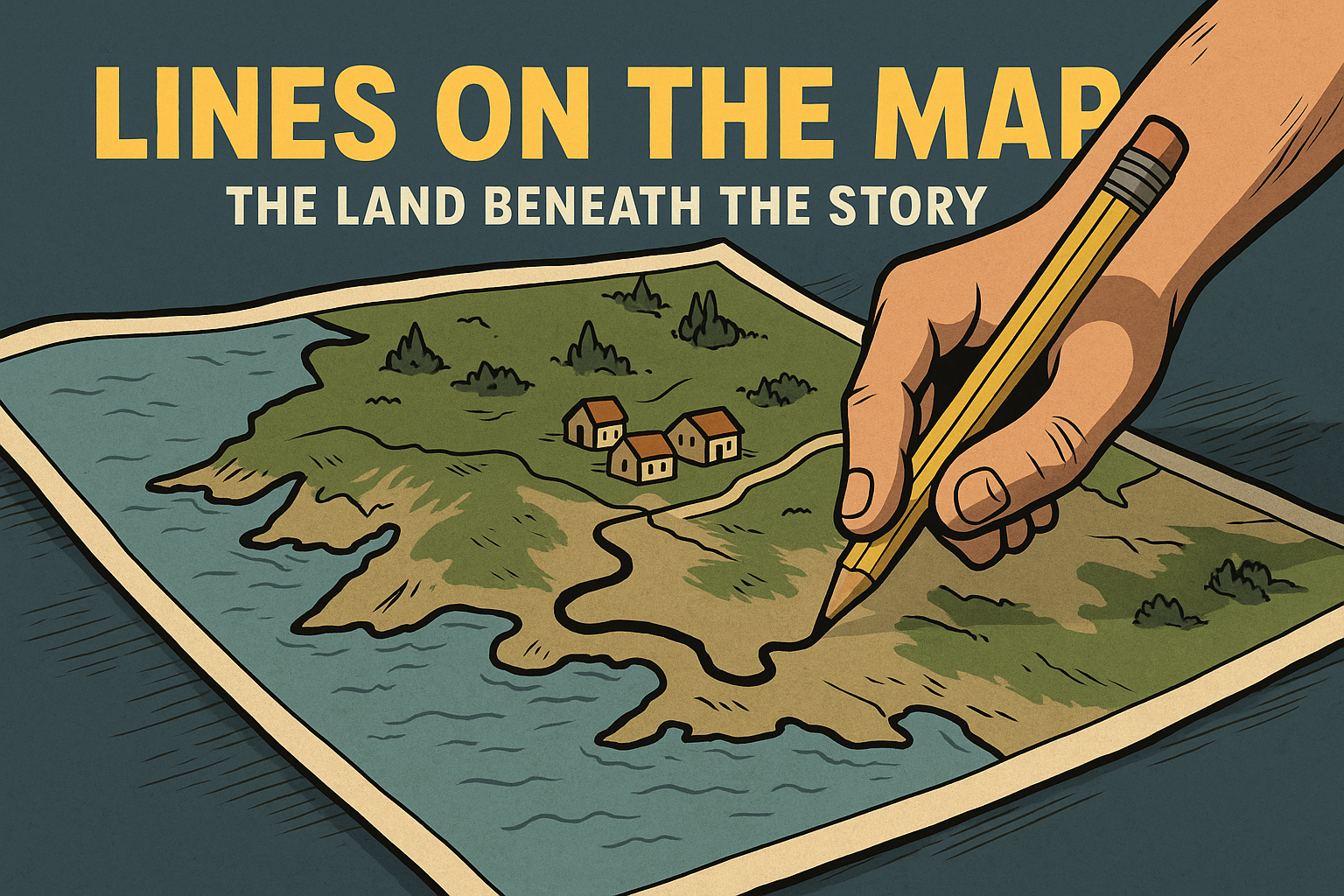
You don’t need a treaty to draw a map.
You just need confidence — and a sympathetic funder.
Across Newfoundland and Labrador, “traditional territory” maps are appearing in the wild: tourism brochures, social-media posts, grant proposals, even public-school hallways. They rarely claim to be legal documents, yet they quietly teach people to see the world as if new borders already exist.¹
These lines begin softly — a graphic here, a caption there — but each repetition makes them feel truer. The maps are not enforceable, yet they reshape expectations about who speaks for the land.
On the Port au Port Peninsula, no treaty exists. No reserve, no trust land, no land-claim settlement (Privately held property within the family and friends does not count). But as soon as Penwaaq L’nu’k’s online messaging shifted from “self-government has nothing to do with land” to “we already have a land base,” (Privately held property within the family and friends does not count) a psychological border was drawn. The next border will be literal — ink on paper, pixels on a screen. Once that map appears, it will not matter that it lacks standing.(Benwah already has that map drafted) What matters is that people start to believe it does.
From Soft Claims to Hard Boundaries
A map is not proof; it’s persuasion.²
Governments, NGOs, and media treat visuals as evidence long before courts do.
Cultural recognition programs often start the chain reaction:
- A funded project produces a “heritage map.”
- That map is cited in another report.
- The citation is used to justify “consultation.”
- Consultation becomes precedent.
By the time a provincial official asks whether the land is disputed, the answer is already drawn — literally.
This is how soft sovereignty works: emotional legitimacy first, paperwork later.³ Labrador saw it during the early stages of the Nunatsiavut negotiations, when maps circulated years before the final agreement.⁴ The visual normalization came first; the legal framework followed.
Mapping Legitimacy
In Canada, “traditional territory” maps have no statutory definition. They’re often built from oral testimony, fragmented archives, or consultant composites. Yet these speculative boundaries routinely appear in:
- Provincial curriculum guides
- Environmental assessments
- Conservation-funded GIS layers
- “Consultation zone” datasets used by federal regulators
Each inclusion inches the line closer to policy. The act of drawing becomes an act of claiming.
Even when multiple groups overlap — as in western Newfoundland — the public rarely sees the contradictions. The composite map looks clean, authoritative, and final.⁵ The fine print saying “not a legal boundary” fades with each share.
Back to Port au Port
The peninsula is a living case study in narrative preparation. There is still no published boundary map from Penwaaq L’nu’k or Benoit First Nation, yet community language increasingly frames the region as theirs already.
- The edited Facebook statement (“we already have a land base”).⁶
- Event invitations referencing “our traditional territory.”
- Local partnerships implying shared jurisdiction.
These steps are rhetorical cartography. They soften resistance before any formal claim appears.
And when that map finally surfaces — perhaps through a grant-funded heritage project — locals will be told it’s harmless, just cultural. But every subsequent use — in reports, signage, or consultation requests — will treat it as factual geography.
When the Line Crosses You
Maps feel objective; that’s their power. But once a map places your home inside someone else’s boundary, you’ve been reclassified without consent.
Private landowners may see cabins, gardens, or trails suddenly located inside an “Indigenous cultural region.” Municipal officials may receive letters asking for consultation on routine maintenance because the road “crosses traditional lands.” None of this has the force of law — until repetition convinces everyone it does.⁷
And pushback carries social risk. Questioning the line invites accusations of intolerance. Accepting it feels safer. That’s how silence becomes the new consent.
The Cartographic Feedback Loop
Once a soft claim gains visual form, policy follows. Conservation agencies overlay “traditional territories” onto 30×30 protected-area goals.⁸ Academic researchers reuse the same shapefiles in climate-adaptation projects. The borrowed data then re-enters government databases labeled “verified community boundaries.”
The cycle turns speculation into infrastructure. By the time the public notices, the line has been digitized, archived, and cited — not once, but hundreds of times.
That’s why even small symbolic acts matter. Every map uploaded without disclaimer is a future policy anchor.
The Map Is Not the Territory ( Yet )
You don’t need a fence to change behavior anymore. You need a file, a font, and a story.
Part 3 showed how one Facebook edit turned private property into a supposed land base. Part 4 shows what comes next: the visual framing of that idea as geography.
When locals say “there’s no land claim here,” officials will soon point to a map and reply, “there is now.”
And that’s the quiet danger — the map becomes the truth it invented.
See Also
- The Quiet Framework
- When “Nothing to Do with Land” Still Means Land
- The Edit That Gave It Away
- Credentialed Silence
- Rehearsed Truth
References
[1] Government of Canada – Self-Government Negotiations and Agreements. https://www.rcaanc-cirnac.gc.ca/eng/1100100031843/1539869205136
[2] Van Assche, Kristof; Greenwood, Robert; Gruezmacher, Monica (2022). “The local paradox in grand policy schemes: Lessons from Newfoundland and Labrador.” Scandinavian Journal of Management 38(3). https://doi.org/10.1016/j.scaman.2022.101212
[3] Guo, Xinli (2025). “Optimal Transfer Mechanism for Municipal Soft-Budget Constraints in Newfoundland.” https://arxiv.org/abs/2508.02171v3
[4] Government of Newfoundland and Labrador – Labrador Inuit Land Claims Agreement. https://www.gov.nl.ca/exec/iar/overview/land-claims/highlights/
[5] Government of Canada – “Backgrounder: Qalipu Mi’kmaq First Nation Enrolment Process.”
[6] Penwaaq L’nu’k – Kji-Wikuom Facebook Page (2025 post edit archive, author collection). (Screenshot 1) (Screenshot 2)
[7] Crown-Indigenous Relations and Northern Affairs Canada – Consultation and Accommodation Guidelines (2020). https://www.rcaanc-cirnac.gc.ca/eng/1100100014664/1609420570587
[8] United Nations Environment Programme – “30x30 Global Biodiversity Framework Targets.” https://www.cbd.int/gbf/