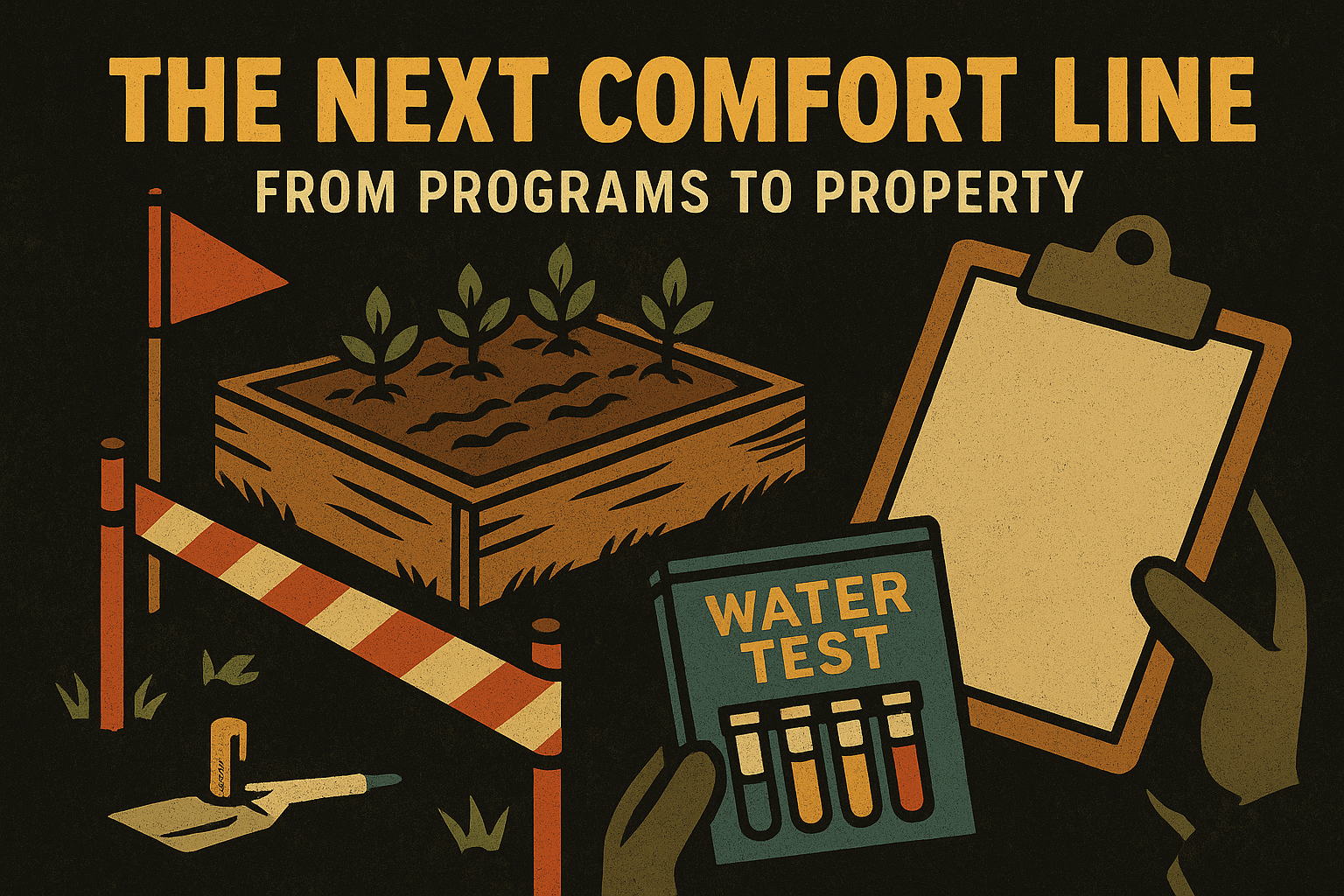
Parts 1–4 showed how denial (“nothing to do with land”) evolves into reframing (“we already have a land base”) [Privately held property within the family and friends does not count], then into mapping (Lines on the Map). This finale follows the last pivot: the move from programs to property, where “healing,” “food security,” and “protecting water” become the moral bridge to managed land and jurisdictional control.¹⁻⁵
The Reassurance Cycle, Completed
You’ve heard the arc in real time:
- “Self-government has nothing to do with land.”
- “We already have a land base.”
- “We are healing the land together.”
In step (1), the public is soothed. In step (2), land becomes normalized in the vocabulary. In step (3), management is cast as moral duty. By then, boundary lines are no longer threatening; they’re comforting. “Healing” makes authority feel like compassion. The comfort line moved, and almost nobody felt it shift.
This move is not accidental. Ottawa’s own planning language marries reconciliation, stewardship, and sustainability targets—so the local idiom lines up with the federal roadmaps.⁴,⁵,¹³,¹⁵,¹⁷
Benevolence as Infrastructure: Healing, Food, Water
Consider the entry points that no one wants to oppose:
- Healing / wellness projects (trauma-informed, culture-restoring)
- Food security programs (gardens, toolkits, grants)
- Water protection and habitat stewardship
Each frames care as the governing logic. In NL, the community-garden/food-program “ecosystem” mostly exists on paper—guides, toolkits, and funding announcements—but many gardens are incomplete or never materialize. (ARCO is notable here); the infrastructure is administrative more than physical.¹⁸–²²
But benevolence is also institutional glue. The same programs plug into reconciliation and SDG dashboards—turning local deliverables (plots built, workshops run, participants served) into compliance proof points for national and global targets.¹³,¹⁵,¹⁷
From Participation to Jurisdiction
Guardians programs are the most candid expression of this logic. The federal Government describes Indigenous Guardians as “eyes and ears on the ground,” funded to exercise stewardship of lands and waters. The model is explicitly about managing space, monitoring development, and maintaining cultural sites—operational authority paired with moral purpose.¹⁻³,¹⁰,¹⁴,¹⁶
Likewise, Indigenous Protected and Conserved Areas (IPCAs) are presented as Indigenous-led conservation where Indigenous governments “have the main role in governing the IPCA and planning for stewardship into the future,” and are openly positioned as core to 30×30.⁶,⁸,¹¹,¹⁶,¹⁸
Two things follow:
- Land is not “taken”—it is cared for.
- Permission structures change. The program that once asked for volunteers now sets conditions on land use—as restoration plans, water testing protocols, wildlife buffers, or “visitor guidelines.”¹⁰,¹⁴,¹⁶
That is how participation becomes jurisdiction: the vocabulary (healing/care) justifies the practice (management/control).
Soft Budgets, Hard Leverage
Once communities depend on outside money for those programs, leverage shifts. This is the soft-budget constraint dynamic: sustained expectations of rescue/funds change local incentives and constrain local choice. NL is a textbook case in municipal finance—narrow tax bases, high fixed costs, and repeated bailouts. That structural dependency explains why communities often align with upper-tier targets (reconciliation metrics, biodiversity targets, climate dashboards): the money arrives braided to the metrics.²³
The point is not to disparage the needs these programs meet; it’s to see how financing architecture channels governance outcomes. When fiscal oxygen comes bundled with “healing the land,” you get a community that must speak the language of healing to breathe.
The Activist-to-Manager Pipeline (Local Case: the ETC)
In NL, the Environmental Transparency Committee (ETC), with figures like Kevin Phillips, operates more as a civic watchdog—issuing press statements, hosting public information sessions, and positioning itself as a trusted voice on environmental issues and land-use concerns. Separately, Jasen Benwah received public funding through Trans Canada Trail to develop a walking trail on family-held private land (image 1, image 2)—another example of how stewardship language and grant support can intersect with private property under the banner of public good.
Though independent in role and tone, both entities illustrate the same deeper shift: the move from opposition to moral authority. This is the next comfort line—not who owns the land, but who speaks for it. Once a group adopts the language of care and protection, it can begin to influence access, interpretation, and even decision-making—without holding legal title.
The maps from Part 4 begin to act as informal operating protocols: where you can go, when you can cut, what you can plant, how you must remediate. And because the justification is healing, food, and water, the public often applauds—even when the gardens don’t exist.¹⁸⁻²²
Most of the promised “community garden” infrastructure across the region remains incomplete, performative, or entirely absent. The programs, toolkits, and public-facing claims still circulate—because the symbol of stewardship matters more than the delivery.¹⁸⁻²²
A forthcoming documentary by Fred Schmidt-Arenales (USA) and Nicole Whalen (An Assistant Professor at MUN originally from the USA) explores this tension directly. The film centers on how subsistence gardening, foraging, and traditional land practices—long used by rural Newfoundlanders to survive—are being displaced by massive energy projects framed as climate solutions. In doing so, it shows how local, lived relationships with land are being symbolically celebrated yet materially undermined—a familiar pattern where moral framing masks functional dispossession.²⁵
This work is not just artistically relevant; it also contributes to a growing academic and cultural consensus around the contradictions of SDG-aligned land use. It affirms—visually and narratively—the same institutional pattern explored in policy critiques, municipal governance literature, and ongoing analysis of Newfoundland land-use dynamics: land-based identity being overwritten by program-based jurisdiction. As such, the film can serve as qualitative evidence in future reports analyzing how rhetorical stewardship functions as soft authority in contested regions like rural Newfoundland.
Similarly, a regional organization—ARCO—features children’s environmental education around gardening and land care. But again, no evidence confirms widespread, operational gardens on the ground—only pedagogical theater, tied to broader messaging about stewardship.²⁶
Closing the Circle: UNDRIP → Action Plan → 30×30/SDGs
The policy plumbing is explicit:
- UNDRIP Act (2021) became law and commits Canada to align federal laws and policy with UNDRIP.⁴,⁷
- The 2023 Action Plan operationalizes that alignment, with departmental strategies now reporting against those measures.⁷,²¹
- SDG reporting then connects UNDRIP implementation to climate, biodiversity, stewardship, and inequality goals—explicitly stating that the UNDRIP Act supports various SDGs and advances Indigenous stewardship for sustainable development.¹³,¹⁵,¹⁷,²¹
- 30×30 (Target 3 under the Kunming-Montreal framework) is nationally framed to emphasize Indigenous-led protection and co-management, with IPCAs as a headline instrument.⁶,⁸,¹¹,¹⁹,²⁰
In short: reconciliation language becomes the soft funnel into territorial stewardship aligned with SDGs; healing becomes the moral warrant; Guardians/IPCA become the operating hands; funding and reporting become the enforcement. The system sells itself as care—because it is—and that is precisely why it succeeds.
From Programs to Property (Without Saying “Expropriation”)
When land is declared managed or stewarded, you don’t need to transfer title to change power. You need protocols, buffers, access conditions, and programmatic duties. The map becomes a workflow; the workflow becomes jurisdiction. And because the script opens with healing and food and water, those who challenge the workflow are framed as challenging care.
That’s the next comfort line. It’s not a line on a map. It’s a line in our heads:
- Land is not owned; it is cared for.
- Authority is not imposed; it is co-developed.
- Control is not taken; it is funded.
And once that line holds, the property regime has already changed.
See also
Part 4 – “Lines on the Map” https://baymansparadox.com/explore/governance/post.php?id=176
Part 3 – “The Edit That Gave It Away” https://baymansparadox.com/explore/governance/post.php?id=175
The Consultant Carousel https://baymansparadox.com/explore/governance/post.php?id=152
The Technocracy of the Base https://baymansparadox.com/explore/governance/post.php?id=145
Governance Without Teeth https://baymansparadox.com/explore/governance/post.php?id=132
Kingmaker Dynamics https://baymansparadox.com/explore/governance/post.php?id=163
References
[1] Government of Canada – Indigenous Guardians (program overview)
[2] Land Needs Guardians – What Guardians Do https://landneedsguardians.ca/what-guardians-do
[3] The Narwhal – New funding & structure for Indigenous Guardians https://thenarwhal.ca/indigenous-guardians-new-funding-system/
[4] Department of Justice – Implementing UNDRIP (UNDRIP Act 2021 overview) https://www.justice.gc.ca/eng/declaration/index.html
[5] United Nations – UNDRIP (full text, PDF) https://www.un.org/development/desa/indigenouspeoples/wp-content/uploads/sites/19/2018/11/UNDRIP_E_web.pdf
[6] First 30×30 – Our Approach & IPCAs https://first30x30.earth/our-approach-and-ipcas/
[7] Department of Justice – UNDRIP Act Action Plan (2023) https://www.justice.gc.ca/eng/declaration/ap-pa/index.html
[8] Canada’s 2030 Nature Strategy (KMGBF implementation; 30×30 context) https://www.canada.ca/en/environment-climate-change/services/biodiversity/canada-2030-nature-strategy.html
[9] Y2Y – Indigenous Guardians leadership on the land https://y2y.net/blog/indigenous-guardians-and-their-leadership-on-the-land/
[10] Reed et al. (2020) – Indigenous guardians as an emerging approach to Indigenous environmental governance https://pmc.ncbi.nlm.nih.gov/articles/PMC7984387/
[11] Canada – 30×30 StoryMap (Target 3 explainer) https://storymaps.arcgis.com/stories/b9885be0220e49d287ed01dafaf1353f
[12] CPAWS-BC – Protecting 30 by 2030 (Indigenous-led protection emphasis) https://cpawsbc.org/protecting-30-by-2030/
[13] Employment & Social Development Canada – 2023 Voluntary National Review (links UNDRIP Act to SDGs)
[14] ILI Nationalhood – Indigenous Guardians explainer https://www.ilinationhood.ca/guardians
[15] ECCC – Federal SDG Goal 10 (UNDRIP Action Plan milestone/goal integration)
[16] Nature for Justice – First 30×30: Indigenous leadership & conservation https://nature4justice.earth/first-30x30-indigenous-leadership-and-conservation/
[17] CIRNAC/ISC – 2024–2025 Departmental Sustainable Development Strategy (UNDRIP Action Plan roadmap reference)
https://www.sac-isc.gc.ca/eng/1752181293900/1752181315245
[18] Food First NL – Organization & mission (food security in NL) https://www.foodfirstnl.ca/
[19] Government of NL – Community Gardens (policy page) https://www.gov.nl.ca/healthyeating/veggiesandfruit/local-vegetables-and-fruits/community-gardens/
[20] Government of NL – Community Garden Support Program (2025 release) https://www.gov.nl.ca/releases/2025/ffa/0306n02/
[21] NL Public Health Association + Food First NL – Food Security roadmap (policy brief) https://www.nlpha.ca/wp-content/uploads/2021/03/FOOD-SECURITY-2015.pdf
[22] The Independent (NL) – Basic income & food insecurity (Health Accord NL context) https://theindependent.ca/news/basic-income-the-answer-to-food-insecurity/
[23] Guo, X. (2025). Optimal Transfer Mechanism for Municipal Soft-Budget Constraints in Newfoundland (arXiv) https://arxiv.org/abs/2508.02171
[24] Boreal Conservation – Indigenous Guardians overview https://www.borealconservation.org/indigenous-guardians
[25] Fred Schmidt-Arenales – film synopsis (subsistence/gardening vs. green megaprojects) https://axeneo7.qc.ca/en/programming/fall-programming-2025/fred-schmidt-arenales
[26] ARCO (Association régionale de la côte Ouest) – children’s community garden & ecology activities https://frenchstreet.ca/lassociation-regionale-de-la-cote-ouest/