
The First Nations Funding Paradox: Billions in Public Spending, but Apparently No Tax Dollars
A Facebook post circulated by the Mi'kmaw Centre has a message for Canadians who believe their tax dollars help finance First Nations programs.
“First Nations People DO NOT GET TAX DOLLARS.”
The accompanying message is equally direct.
“Did you know? Ignorance is not excuse for disrespect, please educate yourselves.”
It continues:
“This is directed towards non-natives who seem to think we exist on the taxpayers dime.”
The Mi'kmaw Centre Facebook page is associated with Jasen Benwah, also known as Jasen Benoit, of Benoit First Nation in western Newfoundland.
The infographic claims First Nations communities are supported through a National Trust Fund, financed by revenues from natural resources and other assets held on their behalf.
According to the graphic, interest earned on that money pays for education, health care, community programs and other services.
There is a problem with that explanation.
Canadian tax dollars do pay for First Nations programs and services. Billions of them.
The federal government's financial records identify the amounts, the programs receiving the money and, in some cases, precisely what the money was spent on.
This is not a matter of political opinion.
It is a matter of public accounting.
Yes, These Are Canadian Tax Dollars
Before examining the numbers, it is worth explaining something government documents often make unnecessarily complicated.
When Canadians pay federal income tax, GST, corporate income tax and other federal taxes, that money goes into the federal government's Consolidated Revenue Fund.
This is the federal treasury.
Parliament authorizes money to be withdrawn from that fund to pay for government programs.
That includes programs administered by Indigenous Services Canada.
The House of Commons explains the process in its financial procedures. Federal revenues are deposited into the Consolidated Revenue Fund, and Parliament authorizes government expenditures from that fund.¹
Canadian tax dollars help pay for First Nations education, health care, housing, infrastructure and band administration.
The federal treasury also receives non-tax revenue, and Ottawa borrows money when necessary. Individual tax payments are not kept in separate accounts earmarked for particular programs.
But that does not change the basic fact.
When Indigenous Services Canada provides money through a federally financed education program, that is taxpayer-supported government spending.
When federal funding pays for band administration, Canadian tax dollars help finance those operations.
When federal money pays for health benefits, medical transportation or community infrastructure, those services are financed through the same tax-supported treasury that pays for other federal programs.
These are Canadian tax dollars at work, alongside other public revenues and government borrowing.
Calling the money a grant, contribution or transfer payment does not change how the federal government finances its expenditures.
Where the Tax Dollars Actually Go
The scale of that spending is substantial.
According to the federal government's 2026–27 Main Estimates, Indigenous Services Canada reported $26,482,739,882 in actual expenditures during the 2024–25 fiscal year.²
That department serves more than First Nations bands alone. Its spending also includes programs involving Inuit and Métis populations, as well as departmental operating costs.
Nevertheless, the records identify billions of dollars in programs supporting First Nations or First Nations and Inuit communities.
First Nations elementary and secondary education — $2.56 billion.
Federal contributions supported schools and educational services.
First Nations and Inuit primary health care — $3.51 billion.
Taxpayer-supported federal spending helped finance health services in eligible communities.
Community infrastructure — $4.90 billion.
Federal contributions supported community infrastructure, including construction and maintenance.
Children, youth and family services — $3.89 billion.
Public money financed prevention and protection programs involving children, young adults, families and communities.
Income assistance — $1.22 billion.
Federal contributions provided income support to eligible on-reserve residents and Status Indians in Yukon.
Band Support Funding — $183.34 million.
These federal grants helped finance First Nations government administration.
These are recorded government expenditures, not projections of what might be spent someday.
They are not distributions from the supposed National Trust Fund described in the Facebook infographic.
They are expenditures from the federal government, financed through Canada's tax-supported public treasury.
Not every dollar listed above went directly to a band council. Some programs finance services through other organizations, and several cover more than one Indigenous population.
But the conclusion remains unchanged.
Canadian tax dollars help finance these programs.
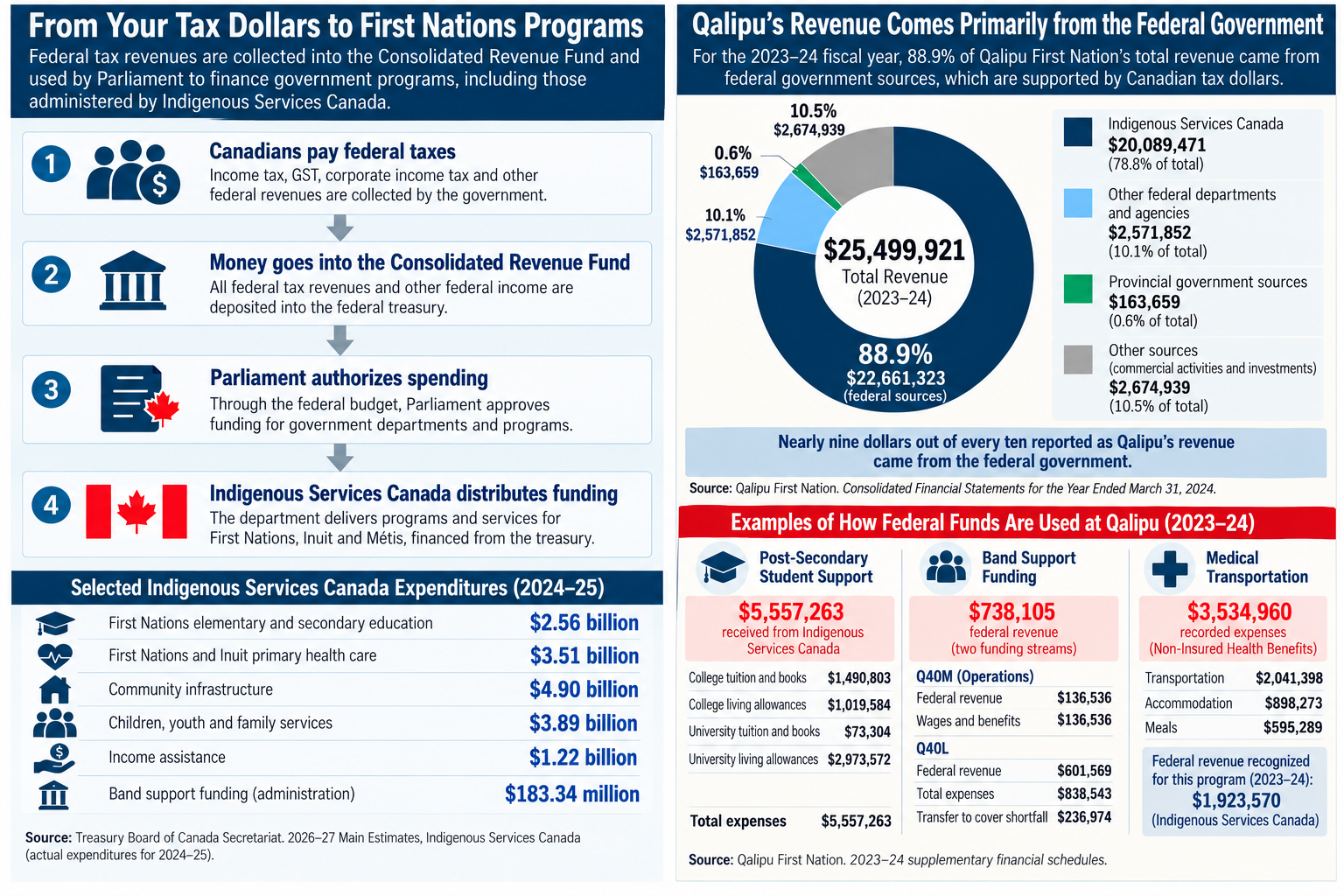
Suggested caption: Canadian federal taxes support the treasury from which Parliament authorizes government spending. Indigenous Services Canada reported $26.48 billion in actual expenditures for 2024–25. Qalipu First Nation's audited 2023–24 accounts show that 88.9 per cent of its revenue came from federal government sources. Sources: Treasury Board of Canada Secretariat and Qalipu First Nation audited financial statements.
What Is This National Trust Fund?
The infographic's explanation contains an element of truth.
The federal government does hold certain money on behalf of First Nations under the Indian Act.
Sections 61 through 69 govern what the legislation calls Indian moneys.
These funds can include revenue from land transactions, resource royalties, leases and other assets.
The money is generally recorded in capital and revenue accounts associated with particular First Nations.
The federal government's Manual for the Administration of Band Moneys explains how those accounts are administered.³
But there is a distinction the infographic fails to make.
Money belonging to a First Nation and held by the federal government is not the same thing as Canadian tax dollars allocated by Parliament.
One is money held for the benefit of particular First Nations.
The other is government spending financed through public revenues, including taxes.
Both exist.
The Public Accounts of Canada reported approximately $587 million in Indian band funds held by the federal government at March 31, 2025.⁴
Those accounts are not evidence of a single national investment fund paying for every First Nations program across Canada.
The federal financial records examined for this article do not establish the existence of the universal National Trust Fund described in the infographic.
They instead show separate band accounts, government grants, program contributions and other sources of revenue.
The existence of band-owned money does not erase the existence of taxpayer-financed government spending.
And Newfoundland provides a particularly revealing example.
Qalipu: A First Nation Without Reserve Lands
Qalipu Mi'kmaq First Nation was established in 2011 under the Indian Act.
Unlike many other First Nations, Qalipu was established without reserve lands.
The federal government made that arrangement explicit when the band was created.⁵
That matters because the infographic describes revenues from resources on reserve lands as a central source of First Nations financing.
Qalipu does not have a reserve-land base generating those revenues.
Yet it receives millions of dollars in federal government funding.
In 2019, Qalipu signed a ten-year funding agreement with Indigenous Services Canada.
The arrangement provided longer-term federal financing for eligible programs.⁶
And Qalipu's audited financial statements show just how significant that financing is.
For the fiscal year ended March 31, 2024, Qalipu reported total consolidated revenue of $25,499,921.
Of that amount:
-
$20,089,471 came from Indigenous Services Canada.
-
$2,571,852 came from other federal departments and agencies.
-
$163,659 came from provincial government sources.
-
$2,674,939 came from other sources.
That means $22,661,323, or approximately 88.9 per cent of Qalipu's annual consolidated revenue, came from federal government sources.⁷
Those federal programs are supported by Canadian tax dollars.
Put simply, nearly nine dollars out of every ten reported as Qalipu's revenue came from the federal government.
That is not an estimate.
It is what Qalipu's own audited financial statements report.
Tuition, Books and Living Allowances
The financial statements also identify specific expenses.
One of the clearest examples is Qalipu's Post-Secondary Student Support Program.
For the 2023–24 fiscal year, a supplementary financial schedule reports $5,557,263 in funding from Indigenous Services Canada.
The same schedule identifies how that money was spent:
-
$1,490,803 for community college tuition and books.
-
$1,019,584 for community college living allowances.
-
$73,304 for university tuition and books.
-
$2,973,572 for university living allowances.
The four categories total $5,557,263.
That is $5.56 million in federal funding, supported by Canadian tax dollars, recorded as paying for college and university tuition, books and living allowances.
The payments are part of a federal program.
They are not evidence of interest distributions from a universal National Trust Fund.
Tax Dollars for Band Administration
Education is not the only example.
Qalipu's financial statements also identify federal Band Support Funding.
One schedule records $136,536 in federal funding, matched by the same amount in wages and benefits.
A second band-support arrangement records $601,569 in federal revenue, alongside $838,543 in expenses.
Those expenses included:
-
$563,068 in wages and benefits.
-
$122,657 in travel and meetings.
-
$84,476 in rent.
-
$68,342 in professional fees.
The arrangement recorded a $236,974 shortfall, covered by a transfer from Lands and Economic Development.⁷
Together, the two band-support arrangements recorded $738,105 in federal revenue.
These figures distinguish money received from the federal government from total spending and internal transfers.
Canadian tax dollars help finance band administration, including salaries and operating expenses.
Whether that spending is appropriate, excessive or insufficient is a separate question.
The funding source is not.
Tax Dollars for Health Benefits and Medical Travel
Health care provides another example.
Qalipu's financial statements report $3,534,960 in medical transportation expenses under the federally funded Non-Insured Health Benefits program during 2023–24.
The expenses included:
-
$2,041,398 for transportation.
-
$898,273 for accommodation.
-
$595,289 for meals.
The same program schedule recorded $1,923,570 in federal revenue for the year.⁷
The full $3.53 million in expenses therefore cannot be described as an identical amount of federal funding received during that accounting period.
But the program is federally funded, and its recorded expenditures show the kinds of services being financed.
Canadian tax dollars help pay for medical transportation and related benefits through this federal program.
Again, this is not speculation about where the money might go.
It is recorded in audited financial statements.
A Question of Accountability
Once the source of the money is established, another question follows.
What happens to the billions of tax dollars spent through these programs?
In May 2026, the Auditor General of Canada examined the federal government's New Fiscal Relationship initiatives.
The audit reported that more than $6.5 billion had been distributed through ten-year First Nations grants by March 31, 2025.
It also identified weaknesses in how Indigenous Services Canada monitored those grants and evaluated their results.
Only 39 per cent of the recipient files examined contained all required annual financial monitoring reports.⁸
These findings concerned the federal grant system generally. They were not findings that Qalipu had misused public funds.
But they raise ordinary questions about public spending.
How much tax-supported funding is being distributed?
Who receives it?
What is purchased?
And how does the government determine whether the programs are achieving their intended results?
Those are questions Canadians can ask about any publicly funded institution.
First Nations programs are not exempt from the need for accurate financial reporting simply because they involve Indigenous communities.
Why Would a Chief Keep Telling His Members This?
There is a larger question behind the Mi'kmaw Centre's Facebook post.
Why would a First Nations chief promote claims that can be challenged by publicly available records?
Bayman's Paradox has previously examined disputed statements associated with Jasen Benwah and Benoit First Nation.
Those articles have addressed representations concerning Indigenous ancestry, organizational governance and public positions on resource development.
The subjects differ, and a disputed statement is not automatically a deliberate falsehood.
But the previous controversies make the latest claim worth examining in a broader context.
What happens when someone in a position of community leadership circulates information that members may reasonably assume is accurate?
There are several possible explanations.
Perhaps Benwah genuinely believes the information he shares.
If so, that raises questions about how carefully he checks claims before presenting them to the public.
Perhaps the information serves a political purpose.
The suggestion that First Nations receive no Canadian tax dollars may reinforce a narrative of financial independence. It may also encourage members to dismiss legitimate questions about government funding.
Or perhaps the message is simply more appealing than the complicated financial reality.
A declaration that First Nations receive no taxpayer money is easier to share than an explanation of federal grants, band accounts, resource revenues and government expenditures.
None of these possibilities establishes Benwah's private motives.
Nor does a false statement, by itself, prove that its publisher knew it was false.
But the consequences of spreading inaccurate information do not depend entirely on the speaker's intentions.
Band members deserve to understand where their organizations' funding comes from, what conditions accompany that money and how it is spent.
They also deserve leadership that can distinguish between legitimate Indigenous financial rights and claims that contradict government accounting records.
The issue is not whether First Nations should receive federal funding.
The issue is whether members are being given an accurate picture of the funding that already exists.
If a chief circulates a claim that Canadian tax dollars do not finance First Nations programs, while federal records show billions in taxpayer-supported spending, whose interests does that misinformation serve?
That is a fair question to ask.
And it becomes more important, not less, when the person circulating the claim occupies a position of community leadership.
The Tax Dollars Are There
The Facebook infographic makes an absolute declaration.
“First Nations People DO NOT GET TAX DOLLARS.”
The federal government's records establish otherwise.
Canadian tax dollars help finance First Nations education, health care, community infrastructure, income assistance and band administration.
Qalipu's audited financial statements provide a local example.
They document millions in federal funding and identify spending on tuition, books, living allowances, administrative salaries and medical transportation.
That does not mean every First Nation receives the same amount of government money.
It does not mean all First Nations revenue comes from Canadian taxpayers.
And it does not mean the existence of federal funding settles questions about treaty obligations, legal entitlements or whether particular programs are justified.
But it does mean the infographic's blanket assertion is false.
The federal treasury is supported by Canadian tax revenues.
Parliament authorizes expenditures from that treasury.
Indigenous Services Canada distributes billions of dollars through federal programs.
And First Nations organizations record those federal payments in their financial statements.
Those are Canadian tax dollars at work.
Whether the spending is justified, properly administered or effective can be debated.
Whether taxpayer-supported federal funding exists cannot reasonably be disputed.
There is also the question of what Benwah gains from promoting such claims. Bayman's Paradox has previously examined controversies involving his public statements about ancestry, organizational governance and resource development. Viewed together, those episodes raise a question about whether the latest claim is another example of a politically useful narrative taking precedence over verifiable facts. Telling First Nations members that their organizations do not depend on Canadian tax dollars may strengthen a message of independence, discourage scrutiny of government funding and reinforce the authority of those presenting themselves as defenders of the community. Whether Benwah deliberately pursues those outcomes cannot be established from the available evidence. But the question deserves attention: when a leader repeatedly advances disputed narratives, is the purpose to inform the membership, or to shape what the membership believes?
A trust fund does not make billions in Canadian tax dollars disappear.
And telling readers to educate themselves does not change what the financial records show.
Related Bayman's Paradox Articles
98% Pretendian: The Screenshot That Vanished
https://baymansparadox.com/post/98-pretendian-the-screenshot-that-vanished
Selective Outrage: When Environmental Principles Depend on Who Profits
https://baymansparadox.com/post/selective-outrage-when-environmental-principles-depend-on-who-profits
Two Hats, One Circle: What Benwah's Meme Accidentally Admits
https://baymansparadox.com/post/two-hats-one-circle-what-benwah-s-meme-accidentally-admits
References
[1] House of Commons of Canada. Financial Procedures — Our Procedure.
https://www.ourcommons.ca/procedure/our-procedure/financialProcedures/c_g_financialprocedures-e.html
[2] Treasury Board of Canada Secretariat. 2026–27 Main Estimates, Indigenous Services Canada, Tables 178 and 180.
https://www.canada.ca/en/treasury-board-secretariat/services/planned-government-spending/government-expenditure-plan-main-estimates/2026-27-estimates.html
[3] Indigenous Services Canada. Manual for the Administration of Band Moneys.
https://isc.gc.ca/eng/1100100032353/1581870508698
[4] Receiver General for Canada. Public Accounts of Canada 2025, Volume I, consolidated financial statements, deposit and trust accounts.
https://www.tpsgc-pwgsc.gc.ca/recgen/cpc-pac/2025/vol1/s2/efc-cfs-eng.html
[5] Government of Canada. Creation of the Qalipu Mi'kmaq First Nation Band, September 2011.
https://www.canada.ca/en/news/archive/2011/09/government-canada-announces-creation-qalipu-mi-kmaq-first-nation-band.html
[6] Qalipu First Nation. Qalipu Takes the Wheel on Own Destiny, Signs Ten-Year Comprehensive Funding Agreement, April 2, 2019.
https://qalipu.ca/qalipu-takes-the-wheel-on-own-destiny-signs-ten-year-comprehensive-funding-agreement/
[7] Qalipu First Nation. Consolidated Financial Statements for the Year Ended March 31, 2024. See consolidated revenue and supplementary schedules for band support, post-secondary student support and medical transportation.
https://qalipu.ca/qalipu/wp-content/uploads/2024/03/Qalipu-First-Nation-Consolidated-03-31-2024.pdf
[8] Office of the Auditor General of Canada. New Fiscal Initiatives With First Nations, May 4, 2026.
https://www.canada.ca/en/auditor-general/our-work/audit-reports/auditor-general-202605-new-fiscal-initiatives-with-first-nations.html