
The Potato Wart Paradox: Canada Loosens the Gate
Newfoundland's quarantine stations, Ottawa's budget cuts, and the agricultural risk Canada says is too small to worry about.
Potato wart.
It sounds like something you would find on an ugly potato at the bottom of a vegetable bin.
Unfortunately, it is considerably more serious than that.
Potato wart is a disease caused by a soil-borne fungus called Synchytrium endobioticum. It can make potatoes unmarketable, threaten entire growing regions and remain dormant in contaminated soil for more than 40 years.¹
It does not make people sick.
It can, however, cause enormous economic damage.
That is why Canada has spent decades trying to prevent contaminated soil from leaving Newfoundland, where the disease has been documented since 1900.¹
And that is why I find Ottawa's latest decision rather interesting.
In April 2026, the Canadian Food Inspection Agency (CFIA) introduced a revised approach to inspecting vehicles leaving Newfoundland through Marine Atlantic's ferry terminals at Port aux Basques and Argentia.
Routine inspections of low-risk vehicles are being replaced with targeted inspections focused on higher-risk vehicles and equipment.¹
The agency says its scientific assessment shows the probability of spreading potato wart through ordinary passenger vehicles is extremely low.
Fair enough.
But Canada's 2025 federal budget also identifies the decommissioning of some vehicle-washing stations as part of CFIA's expenditure reductions.²
So we have a scientific argument for reducing inspections and a financial argument for eliminating infrastructure.
And both lead to the same result.
Fewer routine precautions at the point where Newfoundland's vehicles leave the island.
Meanwhile, the United States is tightening its own restrictions on potatoes coming from Prince Edward Island.
I suppose the obvious question is:
Why is Canada loosening one agricultural barrier while the Americans are tightening another?
The Disease That Doesn't Go Away
Newfoundland has lived with potato wart for more than a century.
According to CFIA, the disease is geographically widespread across the island, although its actual incidence is relatively low and concentrated primarily in backyard gardens.¹
Prince Edward Island is a different story.
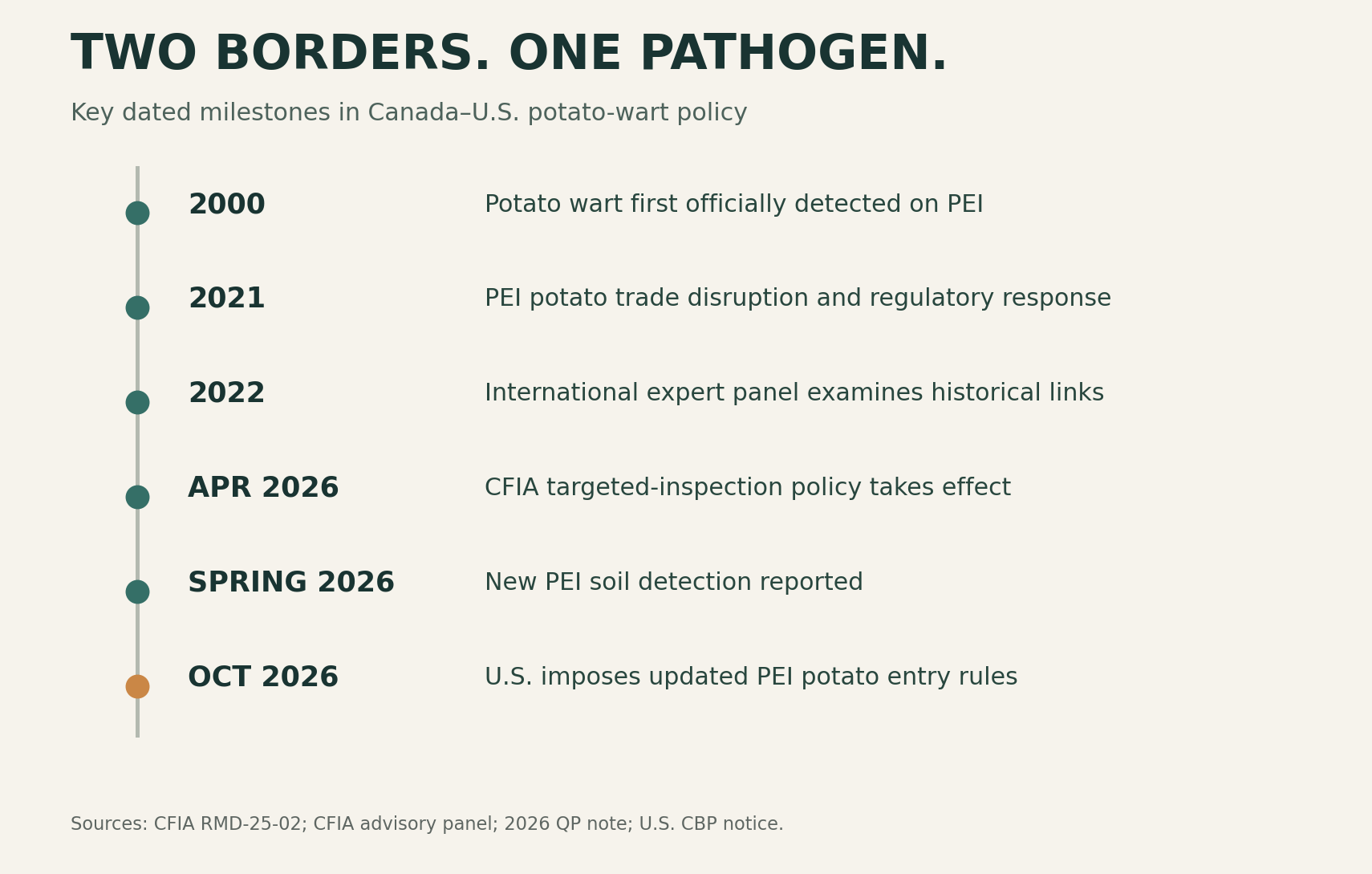
The disease was first officially detected there in 2000. Since then, additional detections have led to restrictions on affected fields, surveillance programs and disruptions to international potato trade.³
The fungus survives through microscopic resting spores in soil.
Those spores can persist for decades without potatoes growing nearby.
There is no ordinary chemical treatment that simply removes potato wart from contaminated farmland. Once a field is affected, managing the disease can become a long-term obligation.
And potato wart doesn't have to destroy an entire harvest to cause trouble.
A detection can trigger movement restrictions and threaten access to export markets.
That is precisely why agricultural quarantine regulations exist.
The Ferry-Terminal Precautions
For decades, CFIA personnel inspected vehicles and equipment leaving Newfoundland at Port aux Basques and Argentia.
Vehicles carrying unacceptable amounts of soil could require cleaning before departure.
These operations were part of Canada's plant-protection system, not simply a courtesy car wash before boarding the ferry.
The reason was straightforward.
Potato wart and potato cyst nematodes can travel in contaminated soil. Agricultural machinery, garden equipment and other items that carry soil can spread these pests between locations.¹
Newfoundland is separated from mainland Canada by water.
That makes ferry departure points particularly useful locations for inspecting vehicles and equipment moving off the island.
But in 2026, CFIA decided the system needed changing.
Its new risk-management document estimates that more than 150,000 vehicles depart Newfoundland annually through the two ferry terminals.
More than are classified as low risk.¹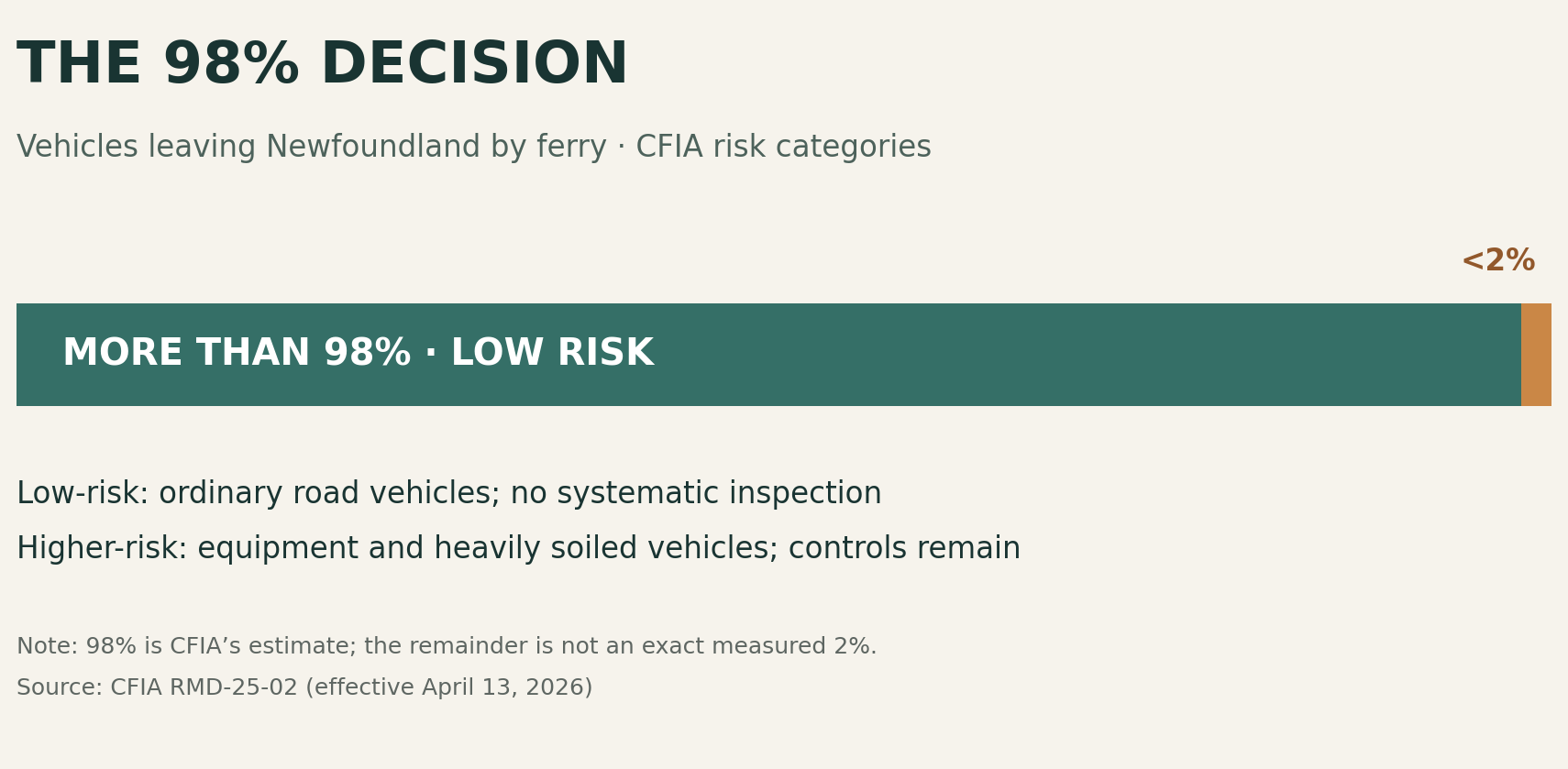
These include ordinary passenger cars, pickup trucks, recreational vehicles, commercial transport trucks and other vehicles normally used on public roads.
CFIA argues that such vehicles rarely encounter contaminated agricultural soil, and that the chances of whatever soil they carry eventually reaching a suitable potato field are extremely low.
Under the revised approach, these vehicles will no longer be systematically inspected.
Higher-risk vehicles and equipment remain subject to inspection and cleaning requirements.
That includes farm machinery, garden equipment, off-road construction equipment, ATVs and vehicles that are heavily soiled or have been used off-road.
So, to be clear, Canada is not removing every precaution.
It is removing routine screening from the overwhelming majority of vehicles leaving Newfoundland.
And whether that is sensible depends on how much faith we place in the risk assessment.
They Actually Found Potato Wart on Vehicles
Here's where the story becomes more interesting.
CFIA's own risk-management document acknowledges that potato-wart spores have previously been recovered from vehicles leaving Newfoundland.
Between 1986 and 1988, surveys detected potato-wart spores in soil samples collected from an average of 0.37 per cent of vehicles examined.¹
That is a small percentage.
Very small.
But it isn't zero.
The same research also detected potato cyst nematodes, another serious agricultural pest.
Later surveys conducted between 2004 and 2009 found no potato-wart spores in the vehicle samples examined.
CFIA cites those findings as evidence that the risk associated with ordinary vehicles is extremely low.
The agency also notes that roads have improved and modern vehicles accumulate less soil than older models.
Those are reasonable considerations.
But the older evidence establishes one thing beyond dispute.
Contaminated material has travelled on vehicles leaving Newfoundland before.
The newer evidence suggests that the risk is now very low.
The question is whether the newer inspection system provides sufficient protection against whatever risk remains.
It is important not to confuse the detection of spores on a vehicle with proof that those spores caused a new outbreak.
For an infection to establish, contaminated material must reach a suitable location under conditions that allow the disease to develop.
CFIA considers that chain of events extremely unlikely for normal passenger vehicles.
But potato wart's ability to persist in soil for decades means the consequences of a successful introduction could extend far beyond the year it happens.
And CFIA acknowledges those consequences could be severe.¹
Follow the Money
Now comes the other part of this decision.
Budget 2025 includes a comprehensive federal expenditure review.
Under that plan, CFIA is expected to achieve savings of up to 15 per cent over three years by reducing duplication, modernizing programs and concentrating resources on what it considers higher priorities.²
Among the activities specifically identified for phasing out:
Vehicle-washing stations.
Not all stations are individually identified in the budget, and the document does not specify the exact savings associated with Newfoundland's two ferry locations.
Nevertheless, the connection between federal expenditure reductions and station decommissioning is right there in the government's own budget.
CFIA's scientific explanation and Ottawa's budget explanation are not necessarily contradictory.
A program can be both expensive and scientifically unnecessary.
But that doesn't make scrutiny unreasonable.
Especially when the program exists to prevent an agricultural disease capable of creating expensive, long-term restrictions.
I would like to know how much money Canada expects to save by changing the Newfoundland operation.
And I would like to know how that amount compares with the potential economic costs of another serious potato-wart incident.
Because government savings and agricultural losses do not necessarily appear on the same balance sheet.
Ottawa might save money.
A farmer somewhere else could eventually pay the price.
We've Had This Conversation Before
If this whole situation sounds familiar, there's a reason.
Canada already tried to reduce the cost of Newfoundland's quarantine stations more than a decade ago.
On September 24, 2012, Liberal MP Judy Foote stood in the House of Commons and challenged proposed cuts to CFIA operations at Port aux Basques and Argentia.⁴
She warned that contaminated soil leaving Newfoundland could threaten potato crops in Prince Edward Island and New Brunswick.
The Conservative government's response came from Pierre Lemieux, then parliamentary secretary to the agriculture minister.
His argument?
Inspecting vehicles was necessary. Paying to wash them was not.
The government intended to continue inspections while making vehicle owners responsible for cleaning contaminated vehicles.
Foote objected, pointing out that the issue involved far more than providing motorists with a free car wash.
She also questioned where contaminated vehicles would be cleaned and how the government would prevent them from picking up additional soil before boarding the ferry.
It was a perfectly reasonable question.
And apparently, answering it wasn't quite as simple as the government suggested.
Seven Years Later, Still Not Resolved
Marine Atlantic's own 2019–20 corporate plan contains a rather revealing section titled "Vehicle Cleaning Services."⁵
According to that document, a June 2012 Treasury Board decision directed Marine Atlantic to assume responsibility for vehicle cleaning at the two CFIA inspection stations.
The reason was a cost-saving measure proposed during CFIA's 2011 Strategic and Operating Review.
But by May 2019, the directive still had not been implemented.
Why?
Unresolved liability issues involving the spread of soil-borne diseases.
There it is.
Seven years after Parliament debated who should wash contaminated vehicles, responsibility for what might happen if contaminated soil spread was still complicating the arrangement.
Marine Atlantic's document went further.
By 2019, CFIA was proposing to move toward prevention, compliance promotion and a self-declaration process, with the eventual goal of eliminating the need for vehicle-washing stations.
Marine Atlantic was reviewing a proposed agreement and expected the outstanding questions to be resolved.
The document does not establish what ultimately happened to every proposed arrangement.
But it shows that reducing or eliminating the washing stations was under consideration long before the 2025 federal budget.
This isn't simply a new scientific decision that appeared in 2026.
It is part of a much longer effort to change the way Newfoundland's quarantine stations operate.
An effort in which cost savings, responsibility for cleaning vehicles and liability for the spread of agricultural disease have all been documented concerns.
And now, fourteen years after that parliamentary exchange, Ottawa is again pursuing a reduction in routine precautions.
Different government.
Different budget.
Same potato wart.
And we're still entitled to ask who pays if the risk calculation turns out to be wrong.
The Newfoundland–PEI Connection
In 2022, CFIA commissioned an international panel of independent experts to examine potato-wart management on PEI.
Its report acknowledged that the precise source of the original introduction was unknown.
However, because of Newfoundland's proximity to PEI and the long history of trade, travel and movement between the two, the panel considered historical exposure from Newfoundland more probable than exposure from many other sources.⁶
Researchers also found that potato-wart isolates from Newfoundland and PEI were genetically very similar.
That supports the possibility of a historical connection.
It does not prove exactly how or when the disease reached PEI.
And it certainly does not mean that every later detection originated in Newfoundland.
Some infections may have persisted undetected for years. Others may be related to contaminated land, potatoes, soil or agricultural equipment already within PEI.
The important point is that a potential historical Newfoundland connection has already been examined by scientists.
This isn't a theory invented to criticize the ferry-terminal changes.
It is part of the existing scientific record.
Another Detection in 2026
In the spring of 2026, CFIA detected potato-wart spores in another previously unregulated PEI field through its national surveillance program.
According to a June 22 federal briefing note, there was no evidence at the time of symptomatic potatoes or spread to neighbouring fields.⁷
The affected farm primarily grew potatoes for processing within PEI rather than export.
That distinction matters.
The detection did not mean PEI's entire potato industry was infected.
Nor does it establish any connection with Newfoundland ferry traffic.
But it was enough to raise renewed concerns about market access.
The United States had already demonstrated how seriously it takes the problem.
In 2021, potato-wart detections led to a suspension of PEI fresh-potato shipments to the United States before trade resumed under additional conditions.
And in October 2026, the Americans tightened the rules again.
October 5: America Tightens the Border
On October 5, 2026, U.S. Customs and Border Protection issued updated entry requirements for potatoes imported from Prince Edward Island under a USDA federal order.⁸
Among the requirements were stronger traceability, restrictions on where certain bulk shipments could be delivered, approved waste-handling procedures and certification requirements.
The objective was to reduce the possibility of potato-wart material reaching American soil through imported potatoes or processing waste.
The United States considers potato wart eradicated domestically.
USDA also lists Synchytrium endobioticum as a federal quarantine pest and a Select Agent because of its potential to threaten American agriculture.⁹
That is a serious classification.
It does not mean potato wart is dangerous to people.
It means the organism is considered capable of causing significant agricultural harm.
And it makes the contrast between the two countries especially noteworthy.
Canada is replacing routine vehicle inspections at Newfoundland ferry terminals with a targeted system.
The United States is imposing additional restrictions on specified PEI potato imports.
Different countries.
Different movement pathways.
Different risk assessments.
But the same disease.
And the same underlying concern: keeping contaminated soil or plant material from reaching susceptible agricultural land.
An Important Distinction
Before going any further, there's something worth clearing up.
A new potato-wart detection in PEI would not automatically prove that the organism arrived from Newfoundland.
And changing the ferry-terminal inspection system does not establish that another outbreak will occur.
The CFIA may be completely correct that its targeted approach provides appropriate protection while avoiding unnecessary inspections.
The old system was not guaranteed to prevent every possible introduction either.
In fact, a large portion of the risk associated with potato wart comes from particular movements of agricultural materials, rather than ordinary passenger traffic.
That is why inspecting higher-risk equipment remains so important.
But accepting that explanation should not mean we stop asking questions.
Especially when the stakes extend beyond the location where the decision is made.
Who Decides What Risk Is Acceptable?
Here's the part I keep coming back to.
More than 150,000 vehicles leave Newfoundland annually through Port aux Basques and Argentia.
CFIA says over 98 per cent are low risk.
That leaves a comparatively small number of vehicles and equipment requiring greater attention.
On paper, concentrating resources on those vehicles makes sense.
But risk assessments involve two separate questions.
How likely is something to happen?
And how serious would the consequences be if it did?
A risk can be extremely unlikely and still justify serious precautions if the consequences are severe enough.
That doesn't automatically mean the old inspections should continue unchanged.
It means the public deserves to understand the full calculation.
What did the old system actually prevent?
What will the new system cost?
How much will taxpayers save?
What happens if the assumptions turn out to be wrong?
And who bears the consequences?
Because the people who benefit from a streamlined inspection process are not necessarily the same people who would suffer from an agricultural outbreak.
That is the local paradox.
A federal government makes a decision to reduce costs and modernize regulations.
A federal agency concludes that the remaining risk is acceptable.
But the consequences of being wrong might fall on potato growers, processors and communities hundreds of kilometres away.
And the American border does not have to remain open simply because Ottawa considers the risk manageable.
The Price of Getting It Wrong
Canada is perfectly entitled to reassess regulations that may have outlived their usefulness.
Science changes.
Transportation changes.
Risk-management practices should change when evidence justifies doing so.
But agricultural biosecurity deserves more than a promise that a low probability makes the danger insignificant.
A disease that can survive in soil for forty years is not necessarily a problem that disappears when next year's budget is balanced.
And when a major trading partner is tightening its own safeguards, Canadians have every reason to ask whether their government has adequately considered the potential economic consequences.
We do not yet know the exact financial savings associated with the Newfoundland station changes.
We do know the disease has been found on departing vehicles historically.
We know PEI has spent decades trying to contain it.
We know the Americans are concerned enough to impose special import requirements.
And we know Canada has decided routine inspection of most vehicles leaving Newfoundland is no longer necessary.
Perhaps the government's assessment is correct.
Perhaps the old system really did provide little additional protection.
But if something goes wrong, it won't matter very much how much Ottawa saved on vehicle washing.
The savings will have been collected in one place.
The bill could arrive somewhere else.
This is Part One of The Potato Wart Paradox, a three-part Bayman's Paradox investigation.
Part Two examines Canadian potato prices, processing costs, international trade and McCain Foods' expanding operations in India.
Part Three explores the potential economic, trade and agricultural-security consequences of future outbreaks, including detailed hypothetical scenarios.
Related Bayman's Paradox Reading
The Local Paradox in Grand Policy Schemes: Why Resets Fail in Newfoundland
https://baymansparadox.com/post/the-local-paradox-in-grand-policy-schemes-why-resets-fail-in-newfoundland
I Hate to Say I Told You So. Actually, No I Don’t.
https://baymansparadox.com/post/i-hate-to-say-i-told-you-so-actually-no-i-dont
Governance Without Teeth: Why Local Councils Fail and Global Agendas Win
https://baymansparadox.com/post/governance-without-teeth-why-local-councils-fail-and-global-agendas-win
References
[1] Canadian Food Inspection Agency — RMD-25-02: Risk Management Document on the Risk of Spreading Potato Wart or Potato Cyst Nematodes via Used Vehicles and Equipment Departing Newfoundland and Labrador. April 13, 2026. https://inspection.canada.ca/en/plant-health/invasive-pests-and-plants/directives/pest-risk-management/rmd-25-02
[2] Government of Canada — Budget 2025, Annex 3: Comprehensive Expenditure Review, Canadian Food Inspection Agency. https://budget.canada.ca/2025/report-rapport/anx3-en.html
[3] Canadian Food Inspection Agency — National Potato Wart Response Plan. https://inspection.canada.ca/en/plant-health/invasive-pests-and-plants/plant-diseases/potato-wart/national-plan
[4] House of Commons of Canada — Debates, September 24, 2012. Exchange between Judy Foote and Pierre Lemieux regarding CFIA vehicle-washing operations at Port aux Basques and Argentia. https://www.ourcommons.ca/documentviewer/en/41-1/house/sitting-151/hansard
[5] Marine Atlantic Inc. — 2019/20–2023/24 Corporate Plan Summary, May 14, 2019. Section: Vehicle Cleaning Services, page 21. https://publications.gc.ca/collections/collection_2020/marineatlantique-marineatlantic/CC527-1-2019-eng.pdf
[6] Canadian Food Inspection Agency — Recommendations of the International Advisory Panel on Potato Wart Disease Management on Prince Edward Island, 2022. https://inspection.canada.ca/en/plant-health/invasive-species/plant-diseases/potato-wart/potato-wart-pei/current-investigation/potato-wart-disease-management-prince-edward
[7] Agriculture and Agri-Food Canada — Question Period Note: Potato Wart, June 22, 2026. https://search.open.canada.ca/qpnotes/record/aafc-aac%2CCFIA-2026-QP-00018
[8] U.S. Customs and Border Protection — Updated Entry Requirements for Potatoes from Prince Edward Island, Canada. October 5, 2026. https://content.govdelivery.com/accounts/USDHSCBP/bulletins/42e07c7
[9] USDA Animal and Plant Health Inspection Service — Potato Wart. https://www.aphis.usda.gov/plant-pests-diseases/potato-wart
[10] VOCM — Union Raises Concerns Over Changes to Potato Wart Regulations. October 2, 2026. https://vocm.com/2026/10/02/312161/