
The Price of a Potato: Why Process It Halfway Around the World?
Canada grows them, processes them, and exports billions of dollars' worth. So why are imports from India growing so quickly — and what does it cost to keep processing at home?
Canada grows potatoes.
Lots of potatoes.
We have the farmland, the farmers, the processing plants, the transportation networks and an established international market.
We are so good at producing frozen potato products that we export billions of dollars' worth every year.
So naturally, we're importing frozen potatoes from India.
Halfway around the world.
I suppose I shouldn't be surprised.
But after looking at Canada's potato trade figures, industrial carbon-pricing rules and McCain Foods' latest overseas acquisition, I have a few questions.
Because there's a difference between growing a potato and making money from one.
And somewhere between the farmer's field and the frozen-food aisle, that difference is becoming rather interesting.
The Potato Is Cheap. Everything Around It Isn't.
Think about the ordinary potato.
It doesn't need elaborate packaging.
It doesn't need to be manufactured.
It can be stored for months under the right conditions, sold in bags and cooked in just about any kitchen in the country.
Yet the people producing it face costs that are anything but simple.
Fuel. Fertilizer. Equipment. Labour. Electricity. Storage. Transportation.
And, depending on the operation, a growing collection of regulatory and environmental compliance requirements.
Now imagine taking that same potato and turning it into frozen french fries.
It has to be transported to a processing facility.
Washed.
Sorted.
Peeled.
Cut.
Blanched.
Fried.
Frozen.
Packaged.
Stored below freezing.
Transported again.
And kept cold until someone finally decides to put it in the oven.
Every stage adds costs.
That is why the price Canadians pay for a bag of raw potatoes and the price they pay for processed potato products can move in different directions.
The price of fresh potatoes can remain relatively low even while the costs of energy, labour, refrigeration, packaging and transportation rise.
And the farmer doesn't necessarily receive more money simply because a bag of frozen fries becomes more expensive.
But it raises another question.
If the raw potato remains relatively inexpensive, how much of the final price is actually about the potato?
And how much is about everything we've built around it?
Canada Is Not Short of Potatoes
Before anybody assumes Canada has forgotten how to grow food, consider the numbers.
According to Agriculture and Agri-Food Canada's Potato Market Information Review 2024–2025, potatoes generated approximately $2.1 billion in Canadian farm cash receipts in 2024.¹
In the 2024–25 marketing year, Canadian exports of potatoes and potato products totalled approximately $3.73 billion.
Of that, frozen potato exports accounted for about $2.71 billion.¹
The United States purchased roughly 90 per cent of Canada's frozen-potato exports.
Think about that.
We have a highly developed processing industry capable of supplying an enormous American market.
Canada's frozen-potato imports, meanwhile, totalled approximately $139.5 million.
We exported more than nineteen times the value of frozen potato products we imported.
Clearly, Canada is not being overrun by imported french fries.
Not yet, anyway.
So why should we care about a comparatively small volume of potatoes arriving from India?
Because small changes can become interesting when you look at their direction.
And the direction of Canada's frozen-potato imports from India is difficult to ignore.
The Indian Potato Connection
Here is where the numbers caught my attention.
Agriculture and Agri-Food Canada's own records show that Canadian imports of frozen potato products from India rose from 81 tonnes in 2023–24 to 629.4 tonnes in 2024–25.¹
That's a 677 per cent increase in volume in a single marketing year.
Not over a decade.
Not over five years.
One year.
The value of those imports also increased, from approximately $240,000 to more than $1.3 million.
An increase of roughly 454 per cent.
Here are the actual figures:
| Marketing year | Import value (CAD) | Quantity |
|---|---|---|
| 2020–21 | $165,246 | 43.0 tonnes |
| 2021–22 | $99,274 | 29.7 tonnes |
| 2022–23 | $209,781 | 53.0 tonnes |
| 2023–24 | $240,434 | 81.0 tonnes |
| 2024–25 | $1,333,032 | 629.4 tonnes |
Source: Agriculture and Agri-Food Canada, using Statistics Canada customs data.¹
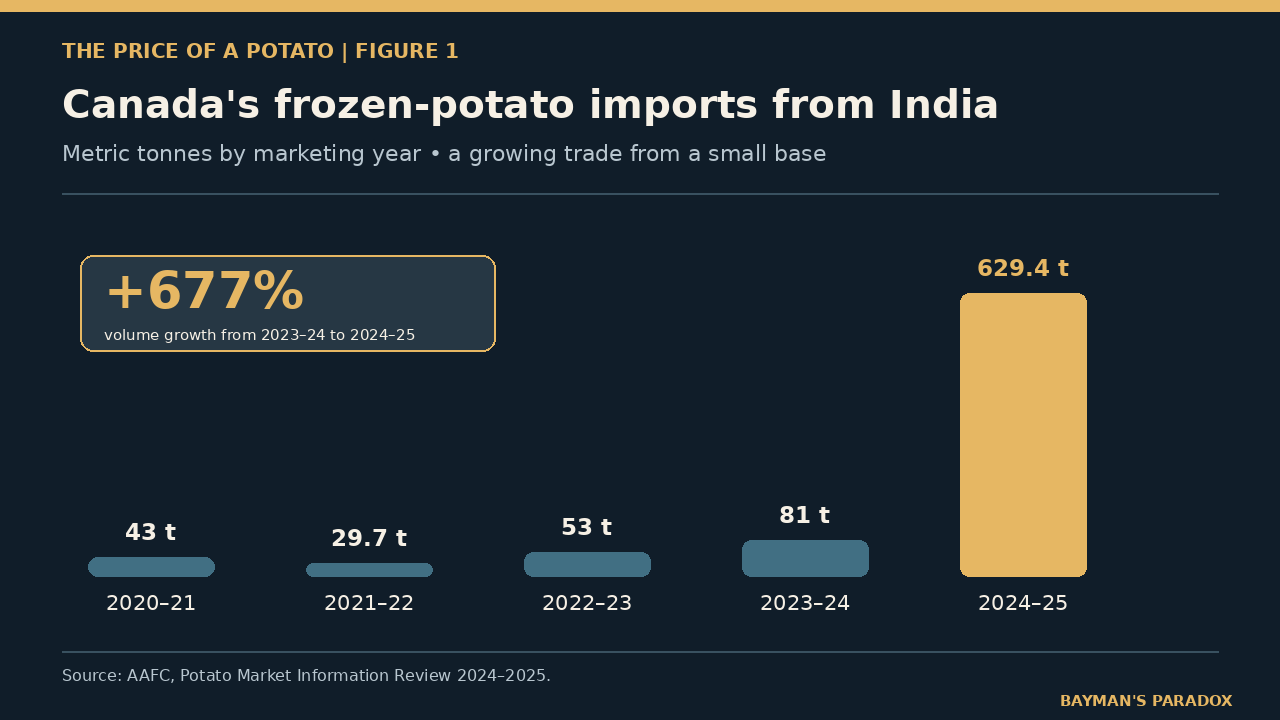
Now, we are told that India still accounts for only about one per cent of Canadian frozen-potato imports.
And that is true.
The United States still supplies approximately 82 per cent by value, with Belgium accounting for another 13 per cent.¹
But I find the percentage of the existing market considerably less interesting than the speed at which India's shipments are growing.
A small market share tells us where things stand today. A 677 per cent increase tells us how quickly things can change.
Major changes in international trade do not necessarily begin with one dramatic announcement.
They can begin with relatively small shipments.
Then larger shipments.
Then new customers, expanded facilities and established distribution arrangements.
By the time an imported product becomes a serious competitor, much of the supply chain may already be in place.
And that is why I am not particularly reassured by the argument that India's share is currently small.
A small share doesn't prove that a takeover is happening.
But it doesn't establish that one cannot happen, either.
And the timing deserves attention.
During the 2024–25 marketing year, Canadian imports of Indian frozen-potato products increased nearly eightfold by volume.
Then, in October 2026, McCain Foods announced an agreement to acquire another frozen-potato processing operation in Gujarat, India.²
Those events do not establish a connection between the imported shipments and McCain's acquisition.
We have not established that McCain produced the imported goods, or that the acquisition was motivated by Canadian market demand.
But we now have two developments worth examining together:
A rapidly expanding import trade and a major Canadian-owned processor investing in additional manufacturing capacity in the same country.
The question is no longer simply why Canada imports frozen potatoes from India.
It is whether those imports represent the early stages of a larger shift in where some of Canada's processed potato products will eventually come from.
And whether anyone is paying attention before that shift becomes difficult to reverse.
Enter McCain Foods
On October 12, 2026, McCain Foods announced an agreement to acquire Falcon Agrifriz Foods' frozen-potato processing business in Gujarat, India.²
The acquisition would add another modern processing facility to McCain's existing Indian manufacturing operations.
It follows a recent C$135 million expansion of McCain's Gujarat operations.
McCain has operated in India since 1998.
In other words, this is not a company that suddenly discovered Indian potatoes last week.
India has an enormous domestic market, a substantial agricultural industry and growing demand for processed foods.
There are perfectly ordinary commercial reasons for a multinational food company to invest there.
The acquisition also remains subject to closing conditions. An announcement is not the same thing as a completed transaction.
But McCain's plans go beyond supplying Indian consumers.
The company says its expanded manufacturing network will help serve domestic demand and international export markets.²
That's the part that interests me.
Canada already has a major frozen-potato processing industry.
India is developing more of one.
And Canadian consumers are already importing frozen potato products manufactured in India.
Those imports cannot presently be tied to McCain's newly announced acquisition.
But they show that India is not merely a hypothetical future supplier.
Indian frozen-potato products are already entering the Canadian market.
And in 2024–25, they entered in substantially greater quantities than the year before.
So what makes processing a Canadian staple overseas commercially attractive?
A Canadian Factory and an Indian Factory
Imagine two factories.
One is in Canada.
The other is in Gujarat.
Both produce frozen french fries to comparable commercial specifications.
Both require potatoes, electricity, water, machinery, workers, packaging and refrigeration.
Both must satisfy the standards of the markets they serve.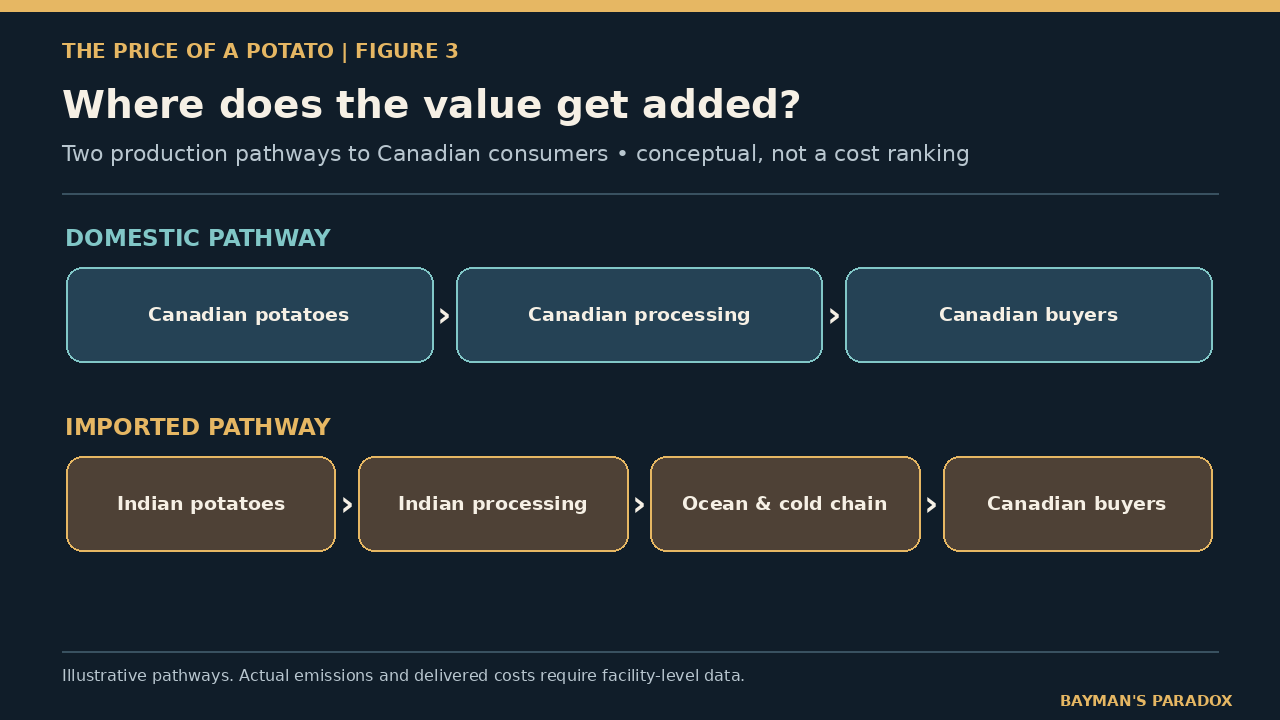
But their operating environments are different.
Canadian wages are different from Indian wages.
Electricity prices are different.
Industrial emissions rules are different.
Raw-material costs are different.
Currency values are different.
And products manufactured in India must absorb international transportation expenses before being sold in Canada.
The Indian factory doesn't automatically win because its wages might be lower.
The Canadian factory doesn't automatically win because it is closer to Canadian customers.
What matters is the total cost of manufacturing and delivering the finished product.
If India's production-cost advantages are large enough to overcome freight, refrigeration, tariffs, port handling and distribution, importing finished products can make commercial sense.
But what makes commercial sense for an international processor is not necessarily what strengthens Canada's domestic processing industry.
That's an important distinction.
And it brings us to carbon pricing.
Yes, Potato Processing Has an Industrial Carbon Standard
Canada eliminated the federal consumer fuel charge effective April 1, 2025.
But that did not eliminate industrial carbon-pricing systems.
Those systems remain part of Canada's industrial regulatory framework.³
Under the federal Output-Based Pricing System (OBPS), covered facilities have emissions limits calculated using standards related to their industrial output.
A facility that exceeds its emissions limit must meet compliance obligations.
A facility that performs better may earn surplus credits.
And here is the detail that makes this particularly relevant to potatoes.
Industrial potato processing has its own category in the federal regulations.
The federal government's quantification guidance identifies an output-based standard of 0.102 tonnes of carbon dioxide equivalent per tonne of potatoes used as raw material, applicable from the 2023 compliance period.⁴
That figure is not a flat tax paid on every tonne of potatoes.
It is part of the calculation used to determine an applicable facility's emissions limit.
Actual compliance costs depend on how much a facility emits, whether it is covered by the federal system, which provincial rules apply and what compliance options or credits are available.
In some provinces, provincial industrial carbon-pricing systems operate instead of the federal OBPS.
We cannot simply assume that every Canadian potato processor pays the same amount.
But the existence of a specific industrial category tells us something important.
Canada recognizes potato processing as an industrial activity with measurable emissions and potential carbon-compliance obligations.
So the next question is obvious.
What does that cost a Canadian processor compared with a competitor manufacturing the same product elsewhere?
We do not yet have the facility-specific numbers.
And without them, nobody should pretend we know exactly how much carbon pricing contributes to the cost of a bag of Canadian frozen fries.
But the competitive question is legitimate.
The Carbon Price Didn't Disappear. It Changed.
In May 2026, the federal government updated its headline industrial carbon-pricing trajectory.⁵
| Year | Headline price per tonne CO₂e |
|---|---|
| 2026 | $95 |
| 2027 | $100 |
| 2028 | $100 |
| 2029 | $100 |
| 2030 | $115 |
| 2035 | $130 |
Again, these are headline carbon-price figures, not the effective amount paid on every tonne of emissions by every potato-processing facility.
The distinction matters.
But so does the broader economic question.
Suppose a Canadian processor faces industrial carbon-compliance costs that a comparable overseas manufacturer does not face in the same form.
Add different labour costs.
Different electricity prices.
Different land costs.
Different financing arrangements.
Different transportation networks.
At some point, a company may find additional overseas production more attractive than expanding domestic capacity.
That possibility has a name.
Carbon leakage.
And it is not a term invented by opponents of carbon pricing.
The Canadian government itself recognizes the danger of production and investment shifting toward jurisdictions with different emissions-related costs, potentially undermining domestic competitiveness without achieving the intended global emissions reductions.³
The output-based system is designed partly to address that problem.
Which raises a question worth asking:
Is Canada's industrial carbon-pricing system protecting domestic manufacturers from losing business overseas, or are some manufacturers still facing competitive pressures that encourage investment elsewhere?
In the potato industry, we have not established the answer.
But it is a measurable question.
Not a philosophical one.
What About the Carbon Cost of Shipping Potatoes Across the World?
Here's another part of this that bothers me.
Canada maintains industrial carbon-pricing systems intended to reduce greenhouse-gas emissions from domestic manufacturing.
Canadian potato processors may face direct or indirect carbon-related costs depending on their facilities, energy sources and provincial regulations.
Meanwhile, Canada is importing frozen potato products manufactured thousands of kilometres away.
Those products have to be grown, processed, frozen, packaged, transported to a port, shipped internationally and delivered through Canada's distribution network.
And frozen products must remain within appropriate temperature conditions along the way.
Every stage requires resources and energy.
So where is the full environmental accounting?
If Canadian manufacturers face additional costs intended to reduce emissions, shouldn't imported products be evaluated against the same environmental objectives?
India has its own emissions policies, but they are not identical to Canada's.
That makes the comparison important.
We cannot simply assume that manufacturing overseas and shipping the finished product across the world produces a better environmental outcome.
Nor can we establish the precise emissions difference without comparing actual facilities, electricity sources, production methods and transportation.
But the absence of that comparison should not become an excuse to ignore the question.
If production shifts toward foreign jurisdictions with different regulatory costs, the result could be fewer emissions recorded in Canada without an equivalent reduction in global emissions.
That is the concern known as carbon leakage.
And it leaves us with a rather obvious question.
If Canada makes domestic potato processing more expensive in the name of reducing emissions, but Canadians increasingly purchase potato products manufactured overseas, what exactly have we accomplished?
Lower Canadian emissions?
Lower global emissions?
Or simply a change in where the manufacturing takes place?
Until we have the numbers, nobody should be claiming an environmental victory.
Especially not when the potatoes have crossed an ocean to reach a country perfectly capable of growing and processing its own.
The Farmer Doesn't Set the Freezer Price
There is another group worth remembering in all this.
Canadian potato farmers.
Most people see a potato as a potato.
But the industry is divided into different markets.
There are potatoes grown for fresh consumption.
Potatoes grown for chips.
Potatoes grown for frozen processing.
Seed potatoes.
And specific varieties grown to satisfy contracts with processors.
A farmer producing processing potatoes is not necessarily free to sell the entire crop wherever the price happens to be highest.
Contracts, variety requirements, quality standards, storage conditions and transportation costs all influence the farmer's options.
The processor also has its own costs and commercial obligations.
So a retail bag of potatoes can remain affordable while the cost of manufacturing frozen fries rises.
And processors can face pressure on their margins even while farmers struggle to obtain higher prices.
Those circumstances are not contradictions.
They are different parts of the same supply chain.
But they create an uncomfortable possibility.
Canada could remain very good at growing potatoes while gradually losing some of the economic advantage of processing them.
That has not been demonstrated by the current import numbers.
But it is precisely the possibility that deserves investigation.
Small Beginnings Can Have Big Consequences
Let's return to that 677 per cent increase.
It is easy to dismiss a growing import category when its market share remains small.
One per cent sounds insignificant.
And at the national level today, it is relatively small.
But what would we be saying if another category of imports grew nearly eightfold in a single year?
Would we dismiss it because the starting point was low?
Or would we ask whether a new trade pattern was developing?
That's the part I find troubling about treating market share as the only meaningful number.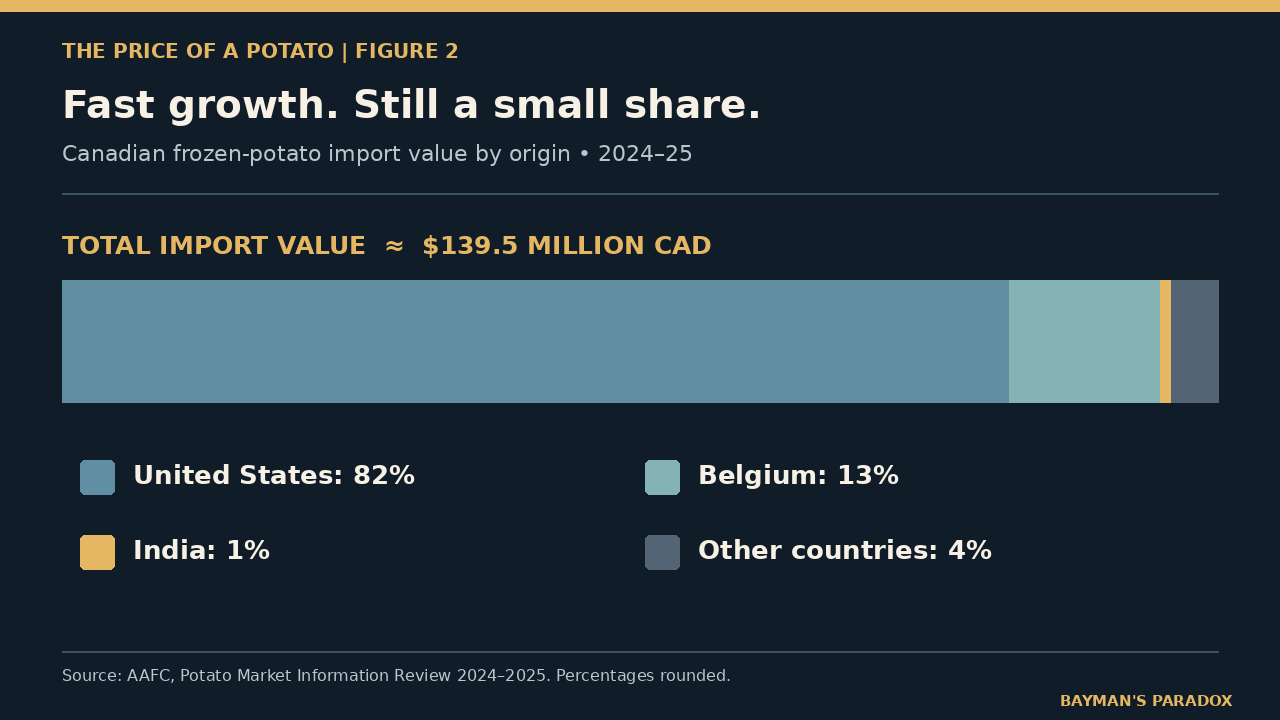
A company doesn't have to dominate a market immediately to establish a foothold.
A supplier doesn't need to replace an entire national industry to win valuable contracts.
And once customers, production facilities, shipping arrangements and distribution channels are established, expanding that trade can become easier.
None of this proves India is taking over Canada's frozen-potato market.
It does explain why an early trend deserves attention before it becomes a major one.
If subsequent trade figures show that India's volumes returned to earlier levels, the 2024–25 surge may prove temporary.
If the increases continue over several years, we will have a much stronger indication of a sustained shift.
That is the test.
The next few years of import data will tell us whether 677 per cent was an extraordinary one-year jump or the beginning of something much larger.
And McCain's announced expansion makes the question all the more interesting.
The Problem With Looking Only at the Cheapest Product
Now suppose, purely for argument's sake, that importing frozen fries from India eventually becomes cheaper than manufacturing a comparable product at a particular Canadian facility.
For a restaurant chain, that could be attractive.
For a retailer trying to contain costs, attractive.
For a processor with operations in several countries, potentially attractive as well.
But what happens if enough purchasing decisions begin moving in that direction?
Canadian factories could face more difficult decisions about future expansion.
Domestic growers could face changes in demand for particular processing varieties.
Local employment and municipal tax revenues could be affected.
And Canada could become more dependent on international logistics for products it already has the agricultural capacity to manufacture.
Of course, the opposite is possible too.
Foreign investments could complement domestic manufacturing rather than replace it.
Canadian companies could grow internationally while maintaining or expanding their operations here.
Competition could encourage Canadian facilities to become more productive.
The available evidence does not tell us which path will emerge.
But it does tell us where the central economic question lies.
It is not simply about where the potato is grown. It is about where the value is added after the potato leaves the field.
And who benefits from that value.
Then There Is Food Security
There is another distinction worth considering.
Having potatoes and having finished potato products are not the same thing.
Canada can grow enormous quantities of potatoes.
But raw agricultural production does not automatically guarantee that the country has enough processing capacity, storage, energy, workers and distribution infrastructure to supply every market.
A processing plant is not something you can build overnight.
Neither is a trained workforce.
Neither is a reliable cold-storage and transportation network.
If a country becomes increasingly dependent on imported finished food products while domestic processing capacity weakens, disruptions elsewhere can suddenly become problems at home.
International shipping delays.
Trade disputes.
Currency changes.
Energy shortages.
Foreign agricultural disease outbreaks.
Unexpected changes in import regulations.
Overseas production can also provide useful backup capacity during domestic shortages.
That is the benefit of diversified international supply chains.
But there is a difference between diversification and dependence.
The question is whether imported products supplement a healthy domestic processing sector or gradually replace some of the capacity that domestic producers once provided.
And that is why the Indian import trend deserves attention now.
Not because 629 tonnes will overwhelm Canada's potato industry.
But because the commercial arrangements behind today's smaller shipments could help support tomorrow's larger ones.
The Potato Wart Connection
Which brings us back to Part One.
Canada is changing longstanding agricultural quarantine practices for vehicles leaving Newfoundland.
The United States has tightened certain requirements on potatoes imported from Prince Edward Island because of potato wart.
Those are documented regulatory developments.
McCain's Indian expansion is documented too.
But there is no evidence that McCain expanded in India because it anticipated a Canadian potato-wart crisis.
Nor is there evidence that its acquisition was intended to replace Canadian production affected by a future outbreak.
Those connections remain hypothetical.
However, one economic reality is worth recognizing.
A multinational company with processing plants in several countries has options that a farmer tied to a particular field does not.
If one region becomes less competitive, experiences disease-related restrictions or loses access to an important market, other facilities may become more valuable.
That is one reason companies diversify their operations.
It does not mean they caused or anticipated a disruption.
It means they may be better positioned to respond when one occurs.
And in an industry where agricultural disease can affect international trade, that flexibility matters.
Part Three will explore what could happen if agricultural biosecurity, international market restrictions and overseas processing capacity begin interacting during a serious supply disruption.
For now, the economic question stands on its own.
The Price of a Potato
Canada is not about to run out of potatoes.
And India has not taken over Canada's frozen-potato industry.
But a 677 per cent increase in imports is not something I am prepared to dismiss simply because the starting point was small.
Particularly when a major Canadian processor is announcing additional investments in the same country, and Canadian manufacturers operate under an industrial carbon-pricing system whose actual competitive effects deserve closer examination.
Maybe India's growing exports simply reflect a competitive new supplier entering the market.
Maybe McCain's expansion has little to do with Canadian demand.
Maybe Canadian processing will remain just as competitive as it is today.
All entirely possible.
But major changes in an industry rarely announce themselves as major changes while they are happening.
Sometimes they begin as a small line in a trade report.
And a year later, someone announces another factory.
Canada already has the farmland.
The farmers.
The expertise.
The processing facilities.
And one of the world's most valuable markets right next door.
We should be asking whether our agricultural, industrial, environmental and trade policies are working together to maintain those advantages.
Not waiting until the market has changed before deciding to investigate why.
Canada can grow the potatoes. Canada can process the potatoes. Canada can export billions of dollars' worth of potatoes.
So why should we wait until imported potatoes become a major competitor before asking whether our own policies are making them more attractive?
This is Part Two of The Potato Wart Paradox, a three-part Bayman's Paradox investigation.
Part One examines Newfoundland's changing agricultural quarantine precautions and the tightening American border.
Part Three explores the potential economic, trade and agricultural-security consequences of future potato-wart disruptions, including detailed hypothetical scenarios.
Related Bayman's Paradox Reading
The Potato Wart Paradox: Canada Loosens the Gate
https://baymansparadox.com/post/the-potato-wart-paradox-canada-loosens-the-gate
The Local Paradox in Grand Policy Schemes: Why Resets Fail in Newfoundland
I Hate to Say I Told You So. Actually, No I Don’t.
https://baymansparadox.com/post/i-hate-to-say-i-told-you-so-actually-no-i-dont
Governance Without Teeth: Why Local Councils Fail and Global Agendas Win
References
[1] Agriculture and Agri-Food Canada — Potato Market Information Review 2024–2025. Canadian potato production, exports and imports; sections 5.3.3.3 and 5.3.3.4 for frozen-potato imports by country of origin.
[2] McCain Foods — McCain Foods Announces Agreement to Acquire Falcon Agrifriz Foods' Potato Processing Business, Strengthening its Manufacturing Network in India. October 12, 2026.
[3] Environment and Climate Change Canada — Output-Based Pricing System. Federal industrial carbon-pricing framework and compliance requirements.
[4] Environment and Climate Change Canada — Quantification Guidance for the Output-Based Pricing System Regulations, updated February 2024. Section 9.7: Industrial Potato Processing.
[5] Environment and Climate Change Canada — Update to the Pan-Canadian Approach to Carbon Pollution Pricing 2023–2030. Industrial carbon-price trajectory updated May 15, 2026.