The 2027 Potato Wart Pandemic: What If the Unthinkable Happens?
One contaminated field. Two countries guarding their borders. Billions in agricultural trade. And an international food industry ready to adapt when somebody else's supply chain breaks.
October 2027: The Potato Wart Pandemic
Imagine it's October 2027.
Somewhere in Atlantic Canada, another potato field has tested positive for potato wart.
Nobody knows where the infection came from.
That hasn't stopped everyone from having an opinion.
Farmers are looking for answers.
Politicians are holding press conferences.
The Canadian Food Inspection Agency is reminding everyone that the risk of spreading potato wart through ordinary passenger vehicles is extremely low.
Newfoundland's ferry inspections are back in the headlines.
Prince Edward Island's potato growers are watching Washington.
And American agricultural authorities are reviewing whether Canadian potato shipments require additional restrictions.
Meanwhile, a multinational food company has manufacturing facilities on several continents.
Somewhere overseas, the frozen-fry production lines are still running.
Business as usual.
Except perhaps for the farmers whose potatoes suddenly can't reach their usual customers.
Welcome to the 2027 Potato Wart Pandemic.
No, it isn't a pandemic that makes people sick.
Potato wart is a plant disease. The word pandemic is being used here as satire, not as a scientific description of an outbreak.
But don't worry.
The economy can catch it instead.
And unlike the potato, the financial consequences don't necessarily stay in the field where the infection is found.
Before Anyone Panics
The events above are fictional.
There is no evidence that Newfoundland's 2026 inspection changes have caused a new potato-wart outbreak, that McCain Foods has anticipated one, or that anybody is deliberately preparing to disrupt Canadian agriculture.
What follows is a thought experiment based on documented events, scientific findings, trade data and existing agricultural regulations.
The purpose is not to predict a disaster.
It is to examine what might happen if decisions that appear unrelated today begin interacting tomorrow.
Because history has a way of making separate decisions look remarkably connected once something goes wrong.
The Ingredients Were Already There in 2026
Let's review what we actually know.
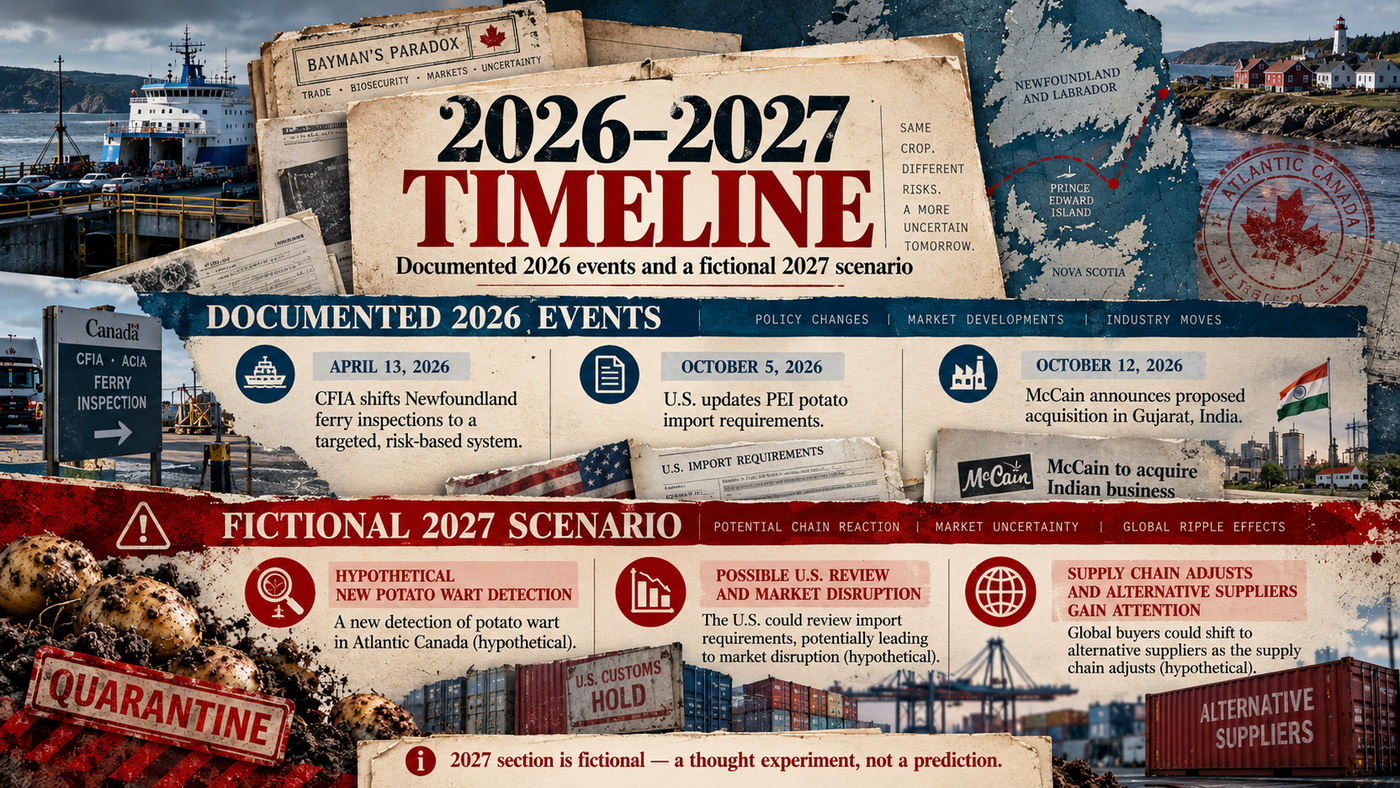
On April 13, 2026, the Canadian Food Inspection Agency introduced a revised risk-management approach for vehicles departing Newfoundland through Port aux Basques and Argentia.¹
More than 98 per cent of the approximately 150,000 vehicles leaving annually were considered low risk.
Routine screening of those vehicles would be replaced with targeted controls, while higher-risk machinery and equipment remained subject to inspection.
CFIA concluded that the probability of spreading potato wart through ordinary road vehicles was extremely low.
It also acknowledged something important.
During surveys conducted between 1986 and 1988, potato-wart spores were detected in soil collected from some departing vehicles.
Later surveys did not detect potato wart in their samples.
And CFIA recognized that the economic consequences of spreading the disease into other Canadian potato-growing regions could be severe.¹
Meanwhile, Budget 2025 specifically identified the decommissioning of some vehicle-washing stations as part of federal expenditure reductions.²
Then came October.
On October 5, 2026, U.S. Customs and Border Protection announced updated import requirements for potatoes originating in Prince Edward Island.
Among the requirements were restrictions on bulk shipments, approved waste-handling arrangements, soil-free potatoes, traceability and additional certification.³
The Americans were not closing the entire border to PEI potatoes.
They were tightening specified controls.
One week later, on October 12, McCain Foods announced an agreement to acquire Falcon Agrifriz Foods' frozen-potato processing business in Gujarat, India.
The company said the acquisition would strengthen its Indian manufacturing network and support domestic demand and international export markets.⁴
And Canada's own agricultural trade statistics showed that frozen-potato imports from India had increased from approximately 81 tonnes in 2023–24 to 629.4 tonnes in 2024–25.
**An increase of roughly 677 per cent in one marketing year.**⁵
That does not make India a dominant supplier. It still represented only about one per cent of Canadian frozen-potato imports by value.
But it establishes that the increase was real.
Three developments.
Agricultural precautions being changed.
American import requirements being tightened.
Overseas processing and trade expanding.
There is no established evidence that these developments were coordinated.
But what happens if a future crisis brings their consequences together?
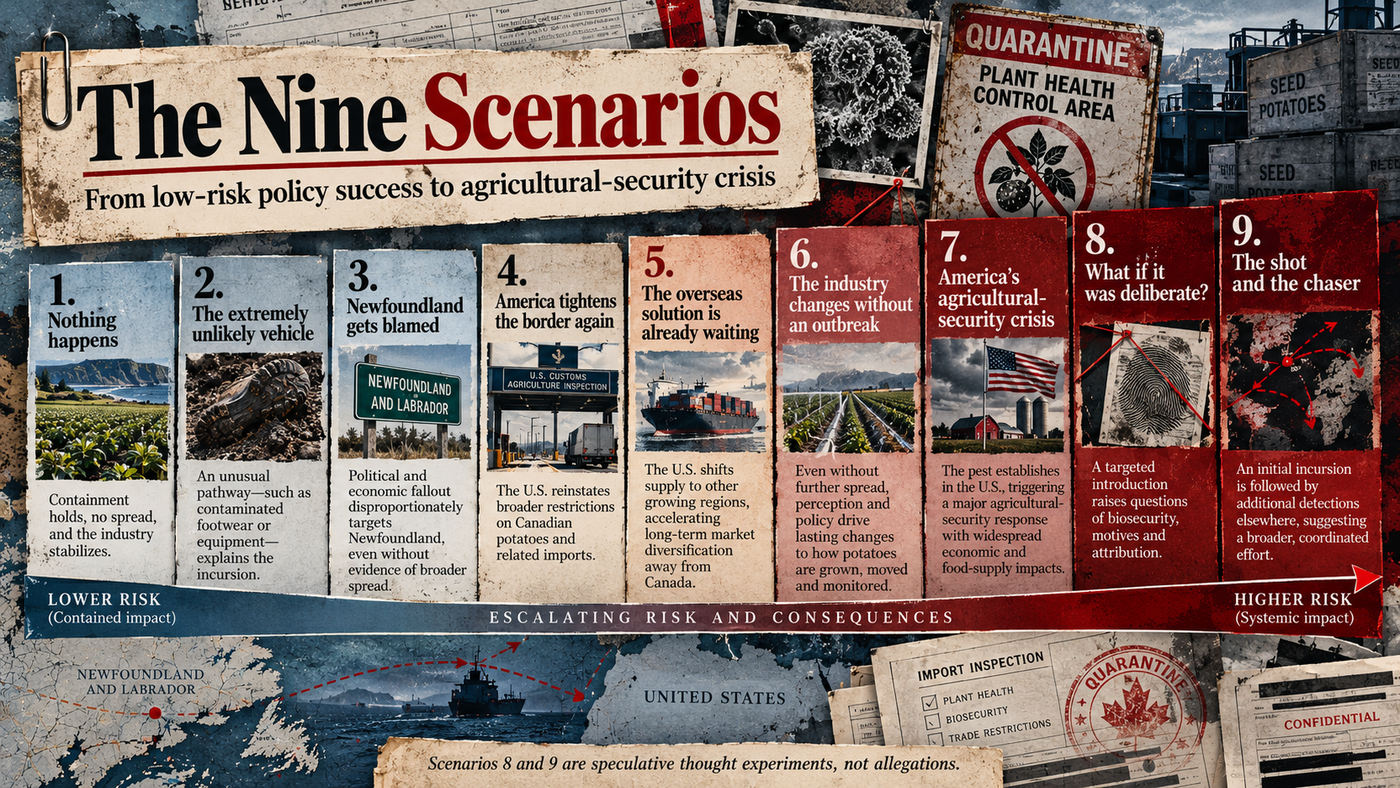
Let's explore nine possibilities.
Scenario One: Nothing Happens
Let's begin with the possibility that should make everyone happy.
Nothing happens.
There is no outbreak attributable to vehicles leaving Newfoundland.
The CFIA's targeted inspection system works as intended.
Higher-risk machinery continues to be screened. Ordinary passenger traffic moves without unnecessary delays.
The government saves money by reducing activities that its risk assessment considers unnecessary.
Farmers remain protected.
Americans continue importing Canadian potatoes.
And the dreaded 2027 Potato Wart Pandemic never materializes.
This is entirely possible.
In fact, it is the outcome CFIA's assessment is intended to support.
The agency argues that ordinary road vehicles are unlikely to carry contaminated soil into contact with susceptible crops under conditions where potato wart could establish.¹
The old inspection system wasn't guaranteed to prevent every potential introduction, either.
So the question is not whether the government eliminated all risk.
No agricultural system can honestly promise that.
The question is whether its replacement controls manage the remaining risk appropriately.
If they do, Ottawa's decision may prove entirely reasonable.
But there's a catch.
How would we know?
If no outbreaks occur, the absence of disease is reassuring. It doesn't necessarily tell us which precautions were essential and which were not.
A meaningful assessment would also examine whether higher-risk vehicles were correctly identified, whether inspection requirements were followed and whether suspicious movements were investigated.
Saving money without experiencing a disaster is a good outcome. Demonstrating that the new system provides adequate protection is an even better one.
That should be the standard.
Not merely waiting to see whether anything terrible happens.
Scenario Two: The Extremely Unlikely Vehicle
Now imagine a less fortunate outcome.
A future investigation identifies a credible connection between contaminated material transported from Newfoundland and a new potato-wart detection elsewhere.
Perhaps the material travelled on equipment that should have received greater scrutiny.
Perhaps a vehicle was incorrectly classified as low risk.
Perhaps an unusual movement escaped the controls that were supposed to apply.
The specific pathway would have to be established through investigation. A new detection by itself would prove none of these possibilities.
But imagine that the evidence eventually points toward something that passed through Newfoundland's ferry system.
Suddenly, the government's risk assessment becomes the centre of attention.
Was the movement consistent with what CFIA classified as low risk?
Were existing rules followed?
Could an inspector have identified the contamination under the previous system?
Did the newer approach fail, or did somebody fail to follow it?
Those are different questions with different consequences.
If a high-risk vehicle bypassed an existing requirement, the problem might be enforcement rather than the policy itself.
If the vehicle was correctly classified as low risk, investigators would need to ask whether the assumptions underlying that category remained valid.
And if the previous system would not have detected the contamination either, restoring it might accomplish little.
But here's why this matters.
Potato-wart resting spores can survive in soil for more than 40 years.¹
A contaminated field may face restrictions long after the immediate investigation ends.
A farmer can lose market access because of where a crop was grown, not because the harvested potatoes visibly look diseased.
And a trading partner may impose precautions before every uncertainty is resolved.
A risk that costs very little to accept can become extraordinarily expensive when it materializes.
The farmer doesn't receive a refund because the original probability was extremely low.
Scenario Three: Newfoundland Gets Blamed
Let's change the situation.
Another field tests positive in Prince Edward Island.
The source is unknown.
There is no evidence connecting the detection to Newfoundland.
But the timing is politically irresistible.
The ferry stations changed their procedures the previous year.
Newfoundland has a long history of potato wart.
An international scientific advisory panel has already discussed Newfoundland as a plausible historical source of the disease in PEI.⁶
And now PEI has another detection.
It would not take long for somebody to connect those dots.
Whether they should be connected is another matter.
Potato wart can remain undetected in soil for decades.
An infection discovered in 2027 might have originated long before the 2026 inspection changes.
Contaminated equipment, soil movement and other agricultural pathways would have to be investigated.
Biological evidence might narrow the possibilities without establishing a precise route or date of introduction.
But political blame rarely waits for a completed scientific investigation.
Imagine the headlines.
Newfoundland ferry inspections cut.
Potato wart detected in PEI.
Farmers demand answers.
Ottawa insists there is no established connection.
And everybody argues over the timing.
Here's the problem.
Even if Newfoundland had nothing to do with that particular detection, the inspection changes might still have made the government's position more difficult to defend publicly.
Because reducing visible precautions before a serious agricultural incident creates a political vulnerability.
The public is entitled to question the decision.
But it should also demand evidence before declaring a cause.
A suspicious timeline is a reason to investigate. It is not a substitute for an investigation.
Unfortunately, that distinction tends to disappear when the cameras arrive.
Scenario Four: America Tightens the Border Again
Now imagine the same PEI detection triggers another American regulatory review.
The United States is already concerned about potato wart.
Its October 2026 requirements demonstrate that it is prepared to impose additional safeguards on PEI shipments.³
Suppose a new detection prompts American regulators to demand more testing, tighter traceability or more restrictive entry conditions.
Some Canadian shipments might face delays.
Certain buyers might reconsider their contracts.
Processing plants receiving Canadian potatoes could have to adjust their procurement arrangements.
And exporters might suddenly face additional expenses.
None of that requires an outright ban on every Canadian potato.
Targeted restrictions alone can create financial pressure.
Potatoes are perishable agricultural products with particular storage and handling requirements.
Processors need predictable deliveries.
Retailers and food-service customers need reliable supplies.
And farmers often make planting and investment decisions long before the crop is harvested.
An export restriction that appears temporary in Ottawa can create a very different reality for somebody trying to sell a harvest.
Canada's frozen-potato industry also depends heavily on the American market.
In 2024–25, approximately 90 per cent of Canada's frozen-potato exports went to the United States.⁵
That is an enormous commercial relationship.
A potato-wart problem confined to one geographic area would not automatically justify restrictions on every Canadian province or every type of processed product.
But regulatory uncertainty can affect commercial decisions even when unaffected regions remain legally eligible to ship.
And now the question becomes economic rather than biological.
How long can a producer wait for the science, the paperwork and the politicians to catch up?
Because potatoes do not stop needing buyers while governments negotiate.
Scenario Five: The Overseas Solution Is Already Waiting
Here is where Part Two enters the story.
Imagine a Canadian supplier loses access to some of its usual business during an agricultural trade disruption.
Customers still want frozen fries.
Restaurants still need potatoes.
Supermarkets still need frozen products.
The demand doesn't disappear simply because one producing region faces restrictions.
So buyers look elsewhere.
They might turn to unaffected Canadian provinces.
They might purchase from American processors.
They might source from established European suppliers.
Or they might investigate manufacturers in Asia, including India.
That is where international processing capacity becomes important.
McCain Foods' October 2026 announcement specifically identifies international export markets among the reasons its expanded Indian manufacturing network is commercially valuable.⁴
That does not mean a Gujarat factory can automatically substitute for production in Canada.
Customers have specifications.
Countries have import requirements.
Shipping frozen food internationally takes time and money.
Factories must have available capacity.
And a proposed acquisition is not the same as an operating expansion under completed ownership.
But global companies with multiple facilities have options.
A farmer with land inside a regulated agricultural zone has considerably fewer.
Let's suppose a hypothetical overseas factory can satisfy a Canadian or American customer's needs when a domestic supplier cannot.
That factory might gain business.
It might increase production.
It might secure a new customer relationship that remains profitable after the immediate disruption ends.
A temporary crisis could produce a lasting commercial change.
Now recall the figures from Part Two.
Canada's frozen-potato imports from India rose 677 per cent by volume between 2023–24 and 2024–25.⁵
That growth occurred before the October 2026 McCain acquisition announcement.
The available figures do not establish that McCain manufactured those imports or that the shipments were preparation for a future disruption.
But they do show that the trade route already exists.
A replacement supplier doesn't need to invent an international market from nothing if customers and distribution channels are already developing.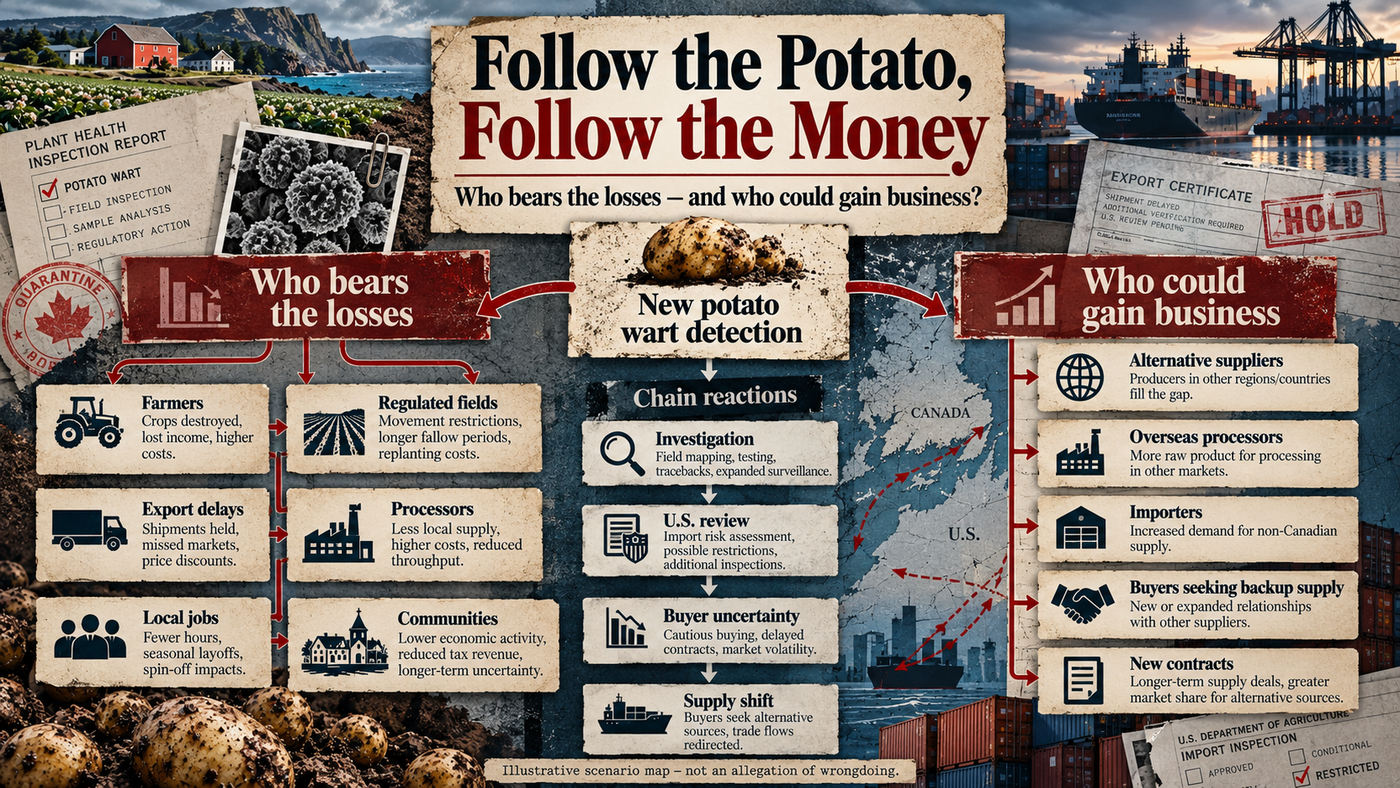
That is not a conspiracy.
It is how international commerce can respond to opportunity.
And it is why a small but rapidly expanding import category deserves attention.
Scenario Six: The Industry Changes Without an Outbreak
Now for what may be the most uncomfortable scenario of all.
Nothing happens to the potatoes.
No major new outbreak.
No dramatic border closure.
No contaminated field dominating the national news.
But Canada's processing industry gradually becomes less attractive for some future investment.
Domestic manufacturers face competition from plants operating under different wage structures, energy costs, financing arrangements and regulatory systems.
Canadian industrial carbon-pricing systems remain part of the manufacturing environment.
The federal Output-Based Pricing System even contains a specific emissions-performance category for industrial potato processing.⁷
That doesn't establish that carbon pricing makes Canadian fries uncompetitive.
We would need actual facility costs, compliance expenses, productivity figures and delivered-price comparisons to know.
But suppose several commercial pressures combine.
A company decides its next expansion will be overseas.
Another customer discovers it can obtain a comparable imported product at a lower price.
A domestic facility postpones modernization.
A regional producer loses a contract.
Then another.
Nothing dramatic has to happen.
No disaster announcement is required.
The change could take years.
And by the time somebody asks why domestic capacity hasn't kept pace, the investment decisions may already have been made.
This is an important distinction.
A country can lose some industrial advantage without losing the ability to grow the raw material.
Canada could continue harvesting enormous quantities of potatoes while an increasing share of certain finished products is manufactured elsewhere.
That is a possibility, not an established trend of domestic collapse.
Canada remains a major net exporter of frozen potato products.
But the direction of future investment matters.
And an agricultural crisis is not necessary for overseas competitors to gain business.
Sometimes economics accomplishes quietly what a disaster would accomplish suddenly.
Which raises an interesting question.
What if we spend years preparing to prevent a disease from destroying the potato industry, while paying insufficient attention to the economic conditions that determine where potatoes get processed?
The potatoes might be perfectly healthy.
The domestic industrial investment could still be weaker than it otherwise would have been.
Scenario Seven: America's Agricultural-Security Crisis
Now let's cross the border.
Imagine potato wart is confirmed in a previously unaffected American potato-growing region.
Not necessarily because it arrived from Canada.
The source would be unknown until investigators established otherwise.
But the consequences could be significant.
The United States treats potato wart as a federal quarantine pest.
More unusually, the pathogen is also regulated as a Select Agent because of its potential agricultural consequences.⁸
That classification matters.
It reflects the seriousness with which American authorities view the organism.
It does not mean every outbreak is an act of terrorism.
Nor does it mean a single detection would produce a nationwide food shortage.
But it does mean the discovery could require an extensive response.
Agricultural authorities might establish regulated areas.
Investigators would examine potentially connected potato movements, equipment and soil.
Affected producers could face restrictions on planting, harvesting or moving regulated material.
Processors might have to identify alternative suppliers.
Other jurisdictions could consider their own precautions.
And the financial effects might extend beyond the field where the pathogen was first detected.
The severity would depend on where the disease was found, how far it had spread and how effectively authorities contained it.
There is also a larger national-security question.
Agriculture is not simply about what food costs at the supermarket.
It is about production capacity.
Processing facilities.
Transportation networks.
Access to seed and planting materials.
Trade relationships.
And the ability to maintain supplies when something unexpected happens.
A country that produces enormous quantities of food can still experience serious economic damage when a major agricultural pest enters a previously unaffected region.
Now imagine the United States begins treating potato-wart prevention with even greater urgency.
Would Washington become more cautious about Canadian agricultural imports?
Would Canada face pressure to demonstrate stronger traceability and pest controls?
Would international buyers diversify contracts away from particular North American regions?
Perhaps.
Those outcomes would depend on the facts of the outbreak and the regulatory decisions that followed.
But they are reasonable subjects for a national-security stress test.
And they bring us back to Canada's own risk calculations.
The same organism that Canada considers extremely unlikely to establish through ordinary vehicle traffic is considered serious enough to receive Select Agent controls in the United States.
Those assessments are not contradictory: one addresses a specific transmission pathway, while the other addresses the potential harm posed by the organism.
But the difference is precisely why probability and consequences must never be confused.
Scenario Eight: What If It Was Deliberate?
This is where the story becomes darker.
So let's be absolutely clear.
There is no evidence that the current Canadian potato-wart situation involves deliberate sabotage.
None of the CFIA inspection changes, PEI detections, Indian import figures or McCain announcements establish intentional wrongdoing.
But agricultural security experts recognize that plant pathogens could, in principle, be used to cause deliberate economic harm.
The United States' Select Agent classification is one reason this broader possibility deserves examination.⁸
Imagine that an entirely hypothetical future potato-wart introduction is eventually determined to have been intentional.
The matter would no longer be solely an agricultural disease investigation.
It could become a criminal investigation.
Authorities would need to establish what happened, whether the introduction was deliberate and who, if anyone, was responsible.
Intent would matter.
Evidence would matter.
And the legal treatment would depend on the facts.
There could also be serious consequences for public confidence.
Consumers might be reassured that potato wart does not infect people, but farmers and trading partners would still be concerned about the integrity of agricultural safeguards.
International buyers could demand additional assurances.
Governments might review their biosecurity systems.
And farmers could face economic consequences despite having no responsibility for the incident.
The unsettling thing about agricultural sabotage is that the people suffering the losses need not be the intended target of a commercial dispute.
Damage to agriculture can spread through contracts, logistics, regulations and public confidence.
But here's the distinction that absolutely matters.
An accidental introduction is not terrorism.
A failure of regulation is not terrorism.
A company benefiting from an outbreak is not evidence of terrorism.
And a government making a disputed risk-management decision is not evidence that it wants an outbreak to occur.
The hypothetical deliberate act would have to be proved.
Until then, it remains precisely what it is.
A hypothetical.
A particularly disturbing one.
But not a finding about the events of 2026.
Scenario Nine: The Shot and the Chaser
And now we arrive at the darkest possibility.
Not the one I am claiming happened.
The one worth examining because it reveals how unevenly risk and economic opportunity can be distributed.
Imagine a future in which several things occur.
A government reduces an agricultural precaution after concluding that the remaining risk is acceptable.
A trading partner remains concerned about the underlying pathogen and has already demonstrated that it is prepared to tighten import restrictions.
Companies continue expanding processing capacity in several countries.
A new agricultural disruption occurs.
Domestic producers face restrictions and financial losses.
Buyers search for alternative sources.
And businesses with available capacity elsewhere gain commercial opportunities.
Now ask a simple question.
Who was exposed to the risk, and who was positioned to benefit from the response?
The farmer did not choose the national inspection policy.
The farmer did not set the American import requirements.
The farmer did not determine where a multinational processor should build its next factory.
But the farmer might bear substantial consequences when those decisions interact.
Meanwhile, a business with operations in several countries could redirect some production or pursue new contracts.
That does not make the business responsible for the disruption.
It makes the business more adaptable.
And adaptability can be commercially valuable.
But What If Someone Saw the Crisis Coming?
Here is where speculation can become dangerous.
Suppose somebody claims that a future disruption was deliberately encouraged because another party was ready to profit from supplying the alternative.
That would be an extraordinary allegation.
It would require extraordinary evidence.
We would need proof of coordination, relevant communications, intentional conduct or other concrete facts connecting the decisions.
The timing of an acquisition would not be enough.
A surge in imports would not be enough.
The decision to reduce inspections would not be enough.
Even the eventual financial benefit would not, by itself, prove a plan.
Knowing that a risk exists is not the same as causing it. Preparing for a disruption is not proof of arranging one.
And there is a far more ordinary explanation for how these events could interact.
Governments seek savings.
Regulators evaluate probabilities.
Trading partners protect their agricultural markets.
Companies seek growth.
Farmers try to make a living.
Each actor makes decisions based on its own priorities.
Then an unexpected event exposes the fact that those priorities were never necessarily aligned.
Nobody has to coordinate a disaster for its consequences to favour some participants more than others.
That is arguably the more important policy problem.
And it is the one we can investigate without inventing a conspiracy.
The Real Shot and Chaser
The first shock could be an agricultural disruption.
The second could be the economic adjustment that follows.
A temporary loss of market access.
A customer switching suppliers.
A processing investment going overseas.
A local producer losing bargaining power.
A new international trade relationship becoming permanent.
That is the shot and the chaser.
The disease creates the immediate problem.
The market adjusts around it.
And the adjustment might outlast the disease investigation.
The potatoes could eventually be cleared for sale.
The contracts might not return.
Follow the Risk. Then Follow the Money.
After all nine scenarios, I keep coming back to the same question.
Who pays for a government's acceptable risk?
The CFIA says the probability of spreading potato wart through ordinary passenger vehicles leaving Newfoundland is extremely low.¹
That may be correct.
The United States says potato wart presents a serious enough agricultural concern to warrant stringent controls.³ ⁸
That is also understandable.
McCain Foods is expanding its international processing operations because companies invest where they see commercial opportunities.⁴
Again, understandable.
None of these positions requires wrongdoing.
But they do create different incentives.
Ottawa has an incentive to manage public spending.
Agricultural regulators have an incentive to focus resources on the pathways they judge most dangerous.
American authorities have an incentive to protect their own agricultural production.
International food companies have an incentive to maintain supply and profitability.
Farmers have an incentive to keep their fields productive and their markets open.
What happens when those incentives collide?
And who has the least ability to recover when they do?
Probably not the multinational company with factories in several countries.
Probably not the government department that approved the risk assessment.
It may be the producer whose farmland becomes subject to restrictions, or the community whose local processing employment depends on contracts being renewed.
The financial consequences can extend far beyond the original cause.
That is why biosecurity cannot be evaluated solely as an exercise in reducing inspection costs.
And food security cannot be evaluated solely by counting how many potatoes a country grows.
We also need to ask who controls the processing capacity, who controls access to markets and who can survive when those markets suddenly change.
The Problem With an Extremely Low Risk
Governments are often required to make decisions under uncertainty.
They cannot eliminate every possible danger.
And they should not preserve every historical regulation simply because it has existed for decades.
But there is a difference between demonstrating that a precaution no longer contributes meaningfully to safety and deciding that the probability of something going wrong is too small to justify the cost.
The distinction becomes important when the potential consequences last for decades.
Potato wart can remain in contaminated soil for more than 40 years.¹
A few weeks of bureaucratic discussion cannot make that biological reality disappear.
Nor can a government guarantee that its largest trading partner will respond to a future detection exactly as Ottawa would prefer.
The United States has already demonstrated that it is willing to tighten Canadian potato-import requirements.
And the international processing industry has already demonstrated that production and investment do not have to remain in the countries where a company first became successful.
This is not a prediction that Canada will lose its potato industry.
Far from it.
Canada remains one of the world's major potato exporters and processors.
But that position is worth protecting.
And protecting it requires more than assuming that the current system will always function as expected.
What Would We Need to Know Before 2027?
Forget the fictional outbreak for a moment.
There are questions Ottawa could answer today.
How much money will the changes to Newfoundland's ferry-terminal inspections actually save?
How effectively will higher-risk equipment be identified under the revised system?
What records will CFIA maintain to demonstrate that the new controls are working?
What would trigger a reassessment of the policy?
How would a future introduction be traced?
What contingency arrangements exist if the United States imposes additional potato-import restrictions?
How much processing capacity could unaffected Canadian regions provide during a serious regional disruption?
And what share of our domestic processing industry might be affected by changing international production costs and investment patterns?
Those are not conspiracy theories.
They are ordinary questions about public policy, agricultural security and economic resilience.
The answers would help determine whether Canada is genuinely reducing unnecessary regulatory costs or shifting poorly understood risks onto people who have little influence over the decision.
Two Weeks to Flatten the Spud
Maybe 2027 arrives and nothing happens.
No new crisis.
No dramatic American restrictions.
No desperate search for overseas fries.
Just another year in which Canadian farmers plant potatoes, processors manufacture food and international trade carries on.
I would be delighted.
But if a serious disruption does occur, I suspect we'll hear some familiar phrases.
The situation is being monitored.
Officials are assessing the available information.
The risk to the public is low.
Additional measures are being considered.
Stakeholders are being consulted.
And somebody, somewhere, will undoubtedly announce that a comprehensive review is underway.
Meanwhile, the farmers will still have bills.
The processors will still have customers.
And the international supply chain will still be looking for the next commercial opportunity.
Perhaps the Canadian system will prove resilient.
Perhaps the new precautions will work perfectly.
Perhaps the economic adjustments will be temporary.
But if they don't, I hope somebody remembers to ask who accepted the original risk and who ended up paying for it.
Because the most troubling version of the Potato Wart Paradox isn't necessarily a deliberate scheme.
It is something much more ordinary.
One institution saves money.
Another imposes restrictions.
A third finds a commercial opportunity.
And the people caught between them discover that nobody was responsible for considering the consequences together.
The potatoes were quarantined. The profits crossed the border.
And if things ever get truly ridiculous, I suppose we already know what the official slogan will be.
Two weeks to flatten the spud.
This is Part Three of The Potato Wart Paradox, a three-part Bayman's Paradox investigation.
The fictional events and scenarios in this article are intended to examine potential policy, trade and agricultural-security consequences. They are not allegations that any person, company or government deliberately introduced potato wart, coordinated a disruption or anticipated an actual future outbreak.
Related Bayman's Paradox Reading
The Potato Wart Paradox: Canada Loosens the Gate
https://baymansparadox.com/post/the-potato-wart-paradox-canada-loosens-the-gate
The Price of a Potato: Why Process It Halfway Around the World?https://baymansparadox.com/post/the-price-of-a-potato-why-process-it-halfway-around-the-world
The Local Paradox in Grand Policy Schemes: Why Resets Fail in Newfoundland
https://baymansparadox.com/post/the-local-paradox-in-grand-policy-schemes-why-resets-fail-in-newfoundland
I Hate to Say I Told You So. Actually, No I Don’t.
https://baymansparadox.com/post/i-hate-to-say-i-told-you-so-actually-no-i-dont
Governance Without Teeth: Why Local Councils Fail and Global Agendas Win
https://baymansparadox.com/post/governance-without-teeth-why-local-councils-fail-and-global-agendas-win
References
[1] Canadian Food Inspection Agency — RMD-25-02: Risk Management Document on the Risk of Spreading Potato Wart or Potato Cyst Nematodes via Used Vehicles and Equipment Departing Newfoundland and Labrador. April 13, 2026. https://inspection.canada.ca/en/plant-health/invasive-pests-and-plants/directives/pest-risk-management/rmd-25-02
[2] Government of Canada — Budget 2025, Annex 3: Comprehensive Expenditure Review. Canadian Food Inspection Agency expenditure-reduction measures, including vehicle-washing station decommissioning. https://www.budget.canada.ca/2025/report-rapport/anx3-en.html
[3] U.S. Customs and Border Protection — TIN #70125511: Updated Entry Requirements for Potatoes from Prince Edward Island, Canada. October 5, 2026. https://content.govdelivery.com/accounts/USDHSCBP/bulletins/42e07c7
[4] McCain Foods — McCain Foods Announces Agreement to Acquire Falcon Agrifriz Foods' Potato Processing Business, Strengthening its Manufacturing Network in India. October 12, 2026. https://www.mccain.com/information-centre/news/announces-agreement-to-acquire-falcon-agrifriz-foods-potato-processing-business/
[5] Agriculture and Agri-Food Canada — Potato Market Information Review 2024–2025. Sections on Canadian frozen-potato exports and imports by country of origin. https://agriculture.canada.ca/en/sector/horticulture/reports/potato-market-information-review-2024-2025
[6] Canadian Food Inspection Agency — Recommendations of the International Advisory Panel on Potato Wart Disease Management on Prince Edward Island. 2022. https://inspection.canada.ca/en/plant-health/invasive-species/plant-diseases/potato-wart/potato-wart-pei/current-investigation/potato-wart-disease-management-prince-edward
[7] Environment and Climate Change Canada — Output-Based Pricing System. Federal industrial carbon-pricing framework, compliance requirements and emissions-performance standards. https://www.canada.ca/en/environment-climate-change/services/climate-change/pricing-pollution-how-it-will-work/output-based-pricing-system.html
[8] United States Department of Agriculture, Animal and Plant Health Inspection Service — Potato Wart. Federal quarantine and Select Agent information. https://www.aphis.usda.gov/plant-pests-diseases/potato-wart